
For many years SEO (Search Engine Optimization) has been perceived as different from SMO (Social Media Optimization).
Both disciplines lived side by side and many practitioners specialized either in one or the other.
Now it’s best to combine both!
With Search Everywhere Optimization the distinction fades
Many argued that SEO is better than SMO for small businesses.
Especially when it comes to “boring” topics that don’t have enough cool material to get attention on social networking sites.
Yet nowadays – in a “search everywhere optimization” environment – the old division does not apply anymore.
SEO itself is inherently social by now.
We had two different disciplines yet by now the distinction fades.
Users search all over the Web.
Just take a look at this infographic from Seosherpa. It seems they show data from 2024:
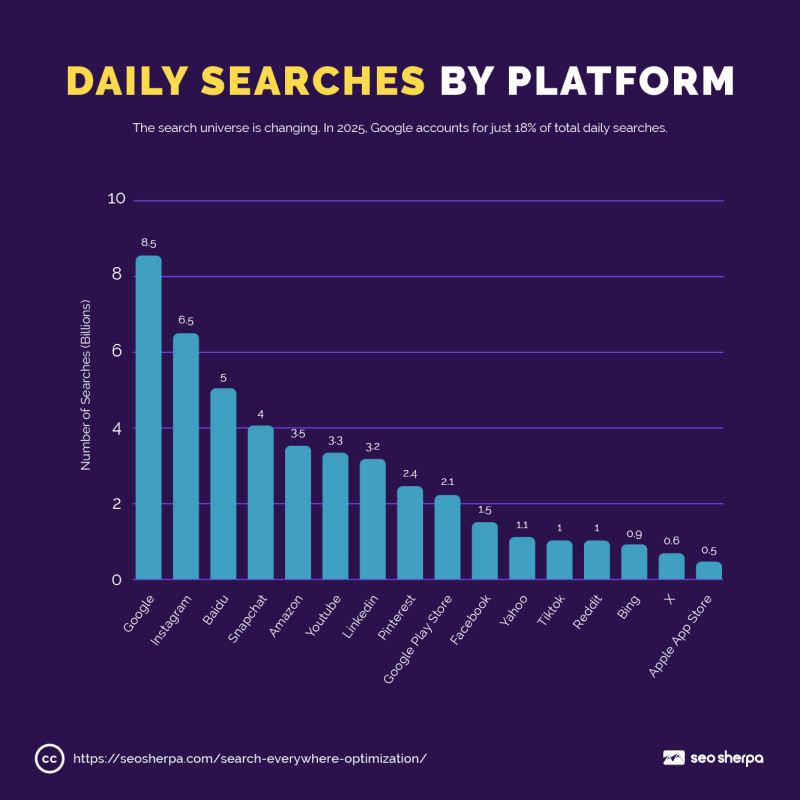
By now the number of searches on various (social) platforms is even larger.
That’s why it’s much more practical to approach search and social channels as one and the same customer journey.
The silo approach of conventional SEO and SMO is not working anymore.
We need a combined focus that takes care of both ends:
- people discovering brands and products on social
- people searching for brands and products they already know.
Add to it AI search and its epochal impact and we have to reassess how we address people on both.
Here comes social SEO!
How does social SEO compare to SEO and SMO?
What’s the difference between search engine and social media optimization?
And where does the combined social SEO appear?
SEO is often technical in nature and aims to convince Google and other search engines to show you higher on result pages.
With AI this gets more and more difficult as links that get clicked become a rarity.
SMO or social media optimization is not really a popular term anymore.
Nowadays you rather manage social media. You don’t only optimize for it to go viral or something.
A whole new discipline called digital PR aims to get publications to spread the word using both search and social channels.
Not to mention content marketing that has similar goals.
I for one consider them to be part of a larger social and content SEO combination.
This way SEO is not just about technical basics.
It’s the whole set of technical, content and social prerequisites that get you online visibility on “search everywhere” platforms.
You’ll get found on social, search and AI tools.
I do not advocate a pure either or approach.
It’s rather the merged “SEO as a side effect of being popular” approach of social SEO.
Don’t get me wrong. I am not against traditional SEO altogether. Yet it’s often just technical and only a much needed foundation.
In fact my blog is still called seo2.blog for a reason!
I believe that technical SEO is just a set of practices inside a larger discipline: SEO2.
It encompasses all three pillars:
- technical
- content
- social
The SEO2 moniker hasn’t caught on and it’s too cumbersome to mention all three aspects of it.
So nowadays it’s just “social SEO” yet it implies technical and content best practices being in place already. Why?
You can’t show up on social without a working website and proper content that is entertaining or helping actual people.
SEO for a social Web does not only consist of mere SEO below the hood of course.
When you’d ask me for numbers I’d say 80% is social and content and 20% technical search engine optimization.
The time and effort spent on it is rather 5% for search and up to 95% for social.
You have to engage, socialize and spread the word on large platforms continuously.
Creating and maintaining content is less time consuming and requires less effort unless you have a huge backlog like I do.
Otherwise updating a post once a year should suffice.
You have to show up on social venues regularly though so that your (personal) brand stays visible and part of the conversation.
Dealing with technical SEO and social media nostalgia
This does not mean that social media is hard or technical SEO is less important.
It means that in social SEO you take standard SEO best practices for granted.
And it means that social media are taken seriously not just as way to promote yourself.
That said I still have to refute the old school SEO mindset of “SEO is just technical” and “everything else is not SEO”.
I respect both disciplines and that’s why I embed them within a larger framework instead of creating tiny niches for both.
As a blogger who covers both SEO and social media I have a good overview of the bigger picture.
I sometimes am too much in love with my own niche of traffic generation by way of Google.
Many bloggers who prefer old school SEO are driven somehow by a strange kind of nostalgia to the good old days
You optimized once, added some links and then you got traffic for an infinite time via Google.
Or you just created a stellar piece of viral content and it exploded.
Social SEO requires consistency and maintaining a steady presence across a few channels.
Do social media and websites even work by now?

The online world has changed ever since popular social media services have become omnipresent.
The social Web is still predominantly run by hyperactive power users or influencers.
Everybody else is almost invisible and gets only a few views here and there.
The John Doe users still mostly lurk.
Traffic to websites from both search and social dwindles in a zero click era as people stay on the big platforms.
Do we even need a website at all?
Can’t we just get found on social and AI apps?
Isn’t it that “SEO is dead” just like every year since its inception?
It’s still possible to succeed on the Web as a small business though.
You can even compete with the big guys when you use the right tools.
You get direct and branded traffic and as secondary effect of the Google and social media campaigns.
Also just the lurkers stay on Google or social media.
Those who are truly interested in your products and services click through.
Thus you get the 10% of active users and save bandwidth on the 90% lurkers who are just after the quick AI summary.
Key differences between SEO and SMO and where they do meet
Here I want to ad several key differences between SEO techniques and SMO practices:
1. When relying on search traffic you’re dependent mostly on Google.
You can get demoted over night for no apparent reason.
Google’s various algorithms can destroy businesses within a blink of an eye!
Social media engagement relies on many sources and real people not just robots.
Even if one site bans you or goes down, the people you networked with will still know you.
Thus they will probably socialize with you elsewhere.
Yet social media traffic is fickle and comes in bursts when you publish or go viral.
Search traffic is a steady stream or at least trickle.
Ideally you combine both!
2. With SEO you sometimes have to wait up to one year to see some results. Why?
Google places you in the so called sand box filter for new sites.
You optimize for a year and only then see some effects.
From social media – when done right – you’ll see traffic from day one.
Existing audiences welcome you with open arms ideally.
The links you gain via social media push you on search too. Thus sometimes you’ll overcome the sand box much quicker.
When you combine both search and social campaigns you can get the best of both worlds: short and long term results.
3. In SEO you have to write long-form content in an often really boring repetitive style.
You still have to use keywords in such a way to rank well. That way real people will get bored with your content.
When it comes to social SEO for the people you attract them right away by outstanding content, and they love it.
Ideally you attract them and they keep on returning. In the best case they will recognize you on search and AI tools as well.
4. Socializing on the Web is just another way of forging business relations with your existing business partners or new ones.
You would probably never befriend an Australian living there while you’re in Europe in real life.
Unless you work as a flight attendant or something.
Yet you can do it easily with social media.
Did you ever befriend anybody at Google?
You can’t even email someone when you’re rankings drop. Google does not care for small business owners.
There is no one to help you unless you spend huge amount on Google ads.
Rather become friends with real people on social media and the same friends will also use Google to find you.
When they choose to make your site a preferred source or click repeatedly on your results Google will also notice.
5. While it’s not true most normal people assume that SEO is shady manipulation.
At the end of the day many business owners are often very hesitant to even admit they practice search engine optimization.
In fact that’s one of the reasons why SEO has such a bad rep. You only notice the bad quality one as a normal user.
Nobody criticizes how the New York Times optimizes it’s website. They have some of the best HTML sitemaps on the Web!
Yet average SEO practitioners get blamed for SPAM every other day. They sometimes deserve it.
Yet SEO is a legit business practice you don’t have to be ashamed of.
Social media has also clickbait, engagement or even rage bait. These are all unethical ways to gain attention at your expense.
Yet reputable business people do not spam or bait either.
Search and social media do not require shortcuts or unethical business practices.
Both are about showing off you and your business or company. You do not have to lie to your potential customers.
So ideally you use just legit methodology in accordance with platform guidelines so that both people and bots appreciate you.
Do not solely depend on Google’s monopoly
I could go on like that. Yet I have to do some SEO work now!
Why? I convince clients that social SEO with its set of built-in SMO techniques is the better choice.
It’s also obvious to many more people that they depend on the Google monopoly.
They have around 90% market share globally for decades.
Ideally I can convince them that including social media in their overall search everywhere optimization efforts is a must!
Help me by spreading the word about this post! Share it with your colleagues!
Related posts:

Suffering from HCU? Holy Cow! Helpful Content System Agony

SEO is Alive! Celebrate with an Online Presence Consultation!

Down-to-Earth Nonprofit SEO Approach: Advice and Resources

Why GEO Can't Replace SEO

WTF is "Parasite SEO"? Is SEO Really "Ruining the Internet"?

How to Use Reddit for Social SEO Without Acting like a Jerk

Social SEO Metrics to Use Instead of Website Traffic

SEO Works! How? Step by Step + Project Examples