
Do you want to optimize your website yourself as a small business owner?
I may have found the best affordable Semrush and Ahrefs alternative for small businesses.
You don’t need to hire an SEO expert to get and implement what this SEO software suggests.
You can use Morningscore for DIY SEO on a budget.
Full disclosure: this is a post made in cooperation with them.
Yet hear me out! I’m usually not that enthusiastic.
This time I really have to tell you about it!
About what? See below!
Introducing Morningscore
Why am I introducing Morningscore to my audience?
Yes, I even reached out to them saying that I want to cover Morningscore in-depth.
I’ve been a huge fan ever since I first tested the tool in 2023.
In this post I present you the reasons for my ongoing support.
Who am I and why am I un/biased?
Let’s rewind a bit though. Why should you trust me on that?
Who am I to tell you which SEO software is best for small businesses?
Back in 2004 I started practicing SEO for clients. Before that I mainly built websites.
We had almost no tools in those days.
That was even before Google Analytics existed.
I worked for both Ahrefs and Semrush throughout the years.
Before Ahrefs was popular I blogged for them for a year around 2015.
I made it engaging and brought in my audience.
Plus I worked for Semrush twice on different parts of the project.
That way I got access to their entire toolsets already early on.
Karsten, the founder of Morningscore, reached out to me back in 2023 when I wrote regularly for Search Engine Land.
I tested the software then and was already amazed at the
- ease of use
- clean interface
- and gamification.
The morning score is not just a metaphor.
It’s an actual score you can check each morning. And people really do.
So it’s hard to tell how un/biased I am.
Right now I’m certainly fascinated by Morningscore and its features.
Why cover Morningscore?
So why do I cover Morningscore?
It could help millions of small businesses!
Yet right now it’s only known by very few people.
Industry leading Semrush has been acquired by Adobe for 1.9 billion Dollars!
How do you compete with that as a small business from Denmark (that’s where Morningscore is based)?
- Playfulness
- Single tasking
- Automation
Morningscore does not only show you where your website ails.
It uses the concept of “missions” to reach particular goals.
It also improves its health by actively using AI on demand for repetitive or otherwise difficult tasks.
On SEO tools like Semrush and Ahrefs you often get overwhelmed with data.
You may barely know what it means!
Semrush e.g. scares you with allegedly “toxic links”!
Morningscore rather inspires you to take positive action.
It shows you the direction you have to advance your SEO in.
Why do people mostly know and use Semrush and Ahrefs?
Why are Semrush and Ahrefs market leading now?
Aren’t they the best options for SEO tools?
Both Ahrefs and Semrush started relatively early.
- Back then the US (Seattle) based Moz (or Seomoz originally) dominated the market.
- Ahrefs was just an unknown SEO tool from Ukraine.
- Semrush or (SEMRush back then) was also quite an obscure Russian tool at the start. Why?
People in the West were wary at first IMHO.
I still had to look up the names of the Semrush founders: Oleg Shchegolev and Dmitri Melnikov.
Unlike Rand Fishkin of Moz they weren’t prominent influencers or even engaging a lot IMHO.
Yet both Ahrefs and Semrush grew slowly but steadily. As noted above I helped both of them!
Then Moz fired their prominent founder and CEO (Rand Fishkin) who was a driving force behind the project.
After that Moz slowly fell behind.
Semrush and Ahrefs could catch up through various initiatives, e.g. the SEO blog I got going for Ahrefs.
Semrush also had a huge marketing team. I remember when a young woman from their team approached me on LinkedIn.
And once we connected, half a dozen beautiful young women from Semrush got suggested.
Semrush just invested a lot into their marketing efforts!
So while Moz had the first mover advantage the market leaders now came closely after.
Now Morningscore is the underdog nobody knows yet.
Yet I predict that a few years from now it might be much bigger than Semrush and Ahrefs combined.
Let me explain first why I do or do not use Semrush and Ahrefs these days.
Why I do and don’t use Semrush and Ahrefs
Don’t get me wrong! Both Semrush and Ahrefs are very useful tools for SEO specialists.
Even their free features or tools do offer some often very insightful data.
Semrush for example may help you assess a website’s authority for free.
It even shows 10 keywords it ranks for on their free version. They also show some inbound links.
Their free website authority checker does not even require an account!
It shows
- a website “authority score” (mine is 29 and “good”)
- most popular pages,
- and even competitors right away.
For my blog these are highly inaccurate though. Why?
The free tool checks the whole domain not the subdomain my blog is hosted on.
When you click to see more data you get shown a sales page.
The cheapest “starter” plan is $199 per month!
Likewise Ahrefs has free tools that allow to check your “domain rating” (mine is 54) or see some backlinks e.g.
I did discover some of mine I didn’t know about yet. Many I knew I had did not show up though!
They also have a free website analytics tool that shows how many people visited your site.
I started testing the latter because my analytics have been swamped with bot traffic.
Sadly Ahrefs experiences the same issue and does not block fake traffic from Asia either.
So by any means, do use these free tools even when the data is limited or compromised!
Do you really need to spend 200 Dollars or more per month?
I’ll be honest with you. As a blogger that is too much money for me!
Even when working for SEO clients I would need to charge them monthly retainers to make this profitable.
I can help everybody.
Sometimes it’s just a short blog post or consultation for a bit more than the 200.
Even when you sign in to your Semrush or Ahrefs account there are some UX issues.
First of all, the tools have accumulated lots of features over the years.
When you look up your site you get inundated with various reports.
It’s hard to prioritize what to do next. Often you get cognitive overload from just looking at the manifold options.
Due to health issues I did for sure. They literally gave me headaches!
So here comes Morningscore which is easier to use and offers almost the same wealth of data and insights for much less.
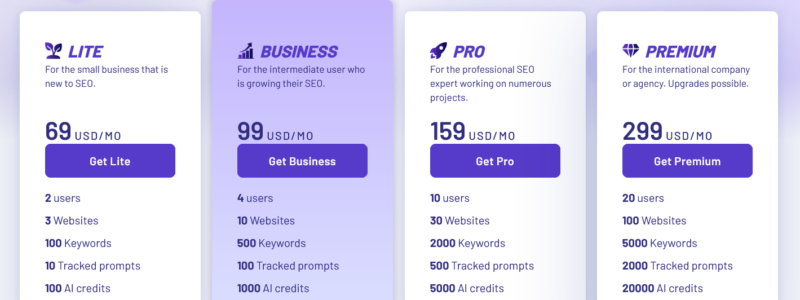
The pricing is quite different. It starts at $69 and the most popular business plan is $99.
Both include the most important AI visibility on Google and ChatGPT.
Why and how can Morningscore help you instead?
Why is Morningscore different?
Instead of clogging the interface with features, metrics and data it gives you space to breathe.
- It focuses on single tasking.
- It has plenty of white space (even though it uses colors) for the eyes to rest.
- And it makes search engine optimization fun.
In Polish, which is my mother tongue, we don’t say Internet users. We call them internauts akin to astronauts.
And that’s exactly what Morningscore depicts. You see a guy in a space suit.
And the founder even dresses in one from time to time.

Just follow Karsten Madsen on Linkedin like I do. He’s an inspiring guy!
So instead of getting flooded with information you can improve your site step by step, one by one, day by day.
Also it’s DIY as in Do It Yourself.
The tool does not require an SEO expert to even understand the metrics and terms you see.
On other tools you will often encounter weird or downright scary terms sounding like taken from a horror flick.
The above mentioned “toxic links” are outmatched by the even scarier keyword cannibalization and the likes.
They even have a menu item called “cannibalization” on Semrush! No kidding!
I simply call it keyword overlap as it’s not always automatically a problem.
Nobody gets eaten! I’m also vegan so it’s literally no body.
And links are not toxic at all. Google called them unnatural links in the past. Yet they don’t use the term anymore it seems. Why?
According to Google’s search advocate John Mueller most spammy links get ignored by Google now.
Yet many Semrush users get scared and tend to remove or “disavow links” left and right.
They do more harm than good that way.
And you know what?
You can check the Semrush site itself, as I did with their German subdomain I worked for in the past.
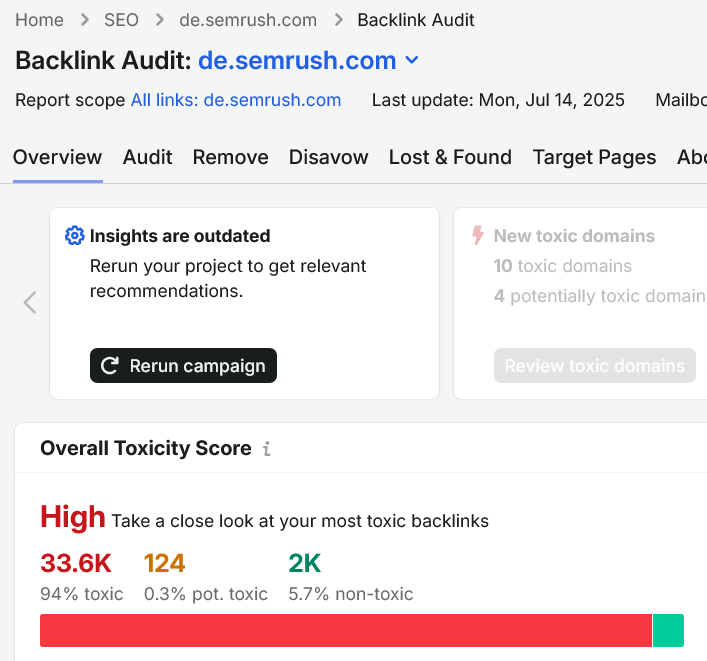
Then you’ll see that 94% of their links are allegedly toxic!
So instead of scaring you to make bad decisions in the worst case, Morningscore empowers and inspires you!
Real life use cases and examples
So how can you use Morningscore to improve your website yourself?
There are of course the standard SEO software use cases.
Plus some tools and features only Morningscore offers IMHO.
Let’s start with the most obvious ones.
I use examples and screen shots from my own blog here.
To test and review Morningscore properly I tried to find and fix my own issues!
I started with the basics of course.
Keyword research and tracking rankings.
Often tracking rankings on Google search is hard for starters. Why?
You don’t even know yet what queries you rank for or want to rank for.
Morningscore solves this problem by simply suggesting keywords you already show up for.
You can’t find the terms you are interested in or that reflect your market right away? Just click “more suggestions”.
I did a few times to find all the ones I cared for plus some new ones that worked for me as well.
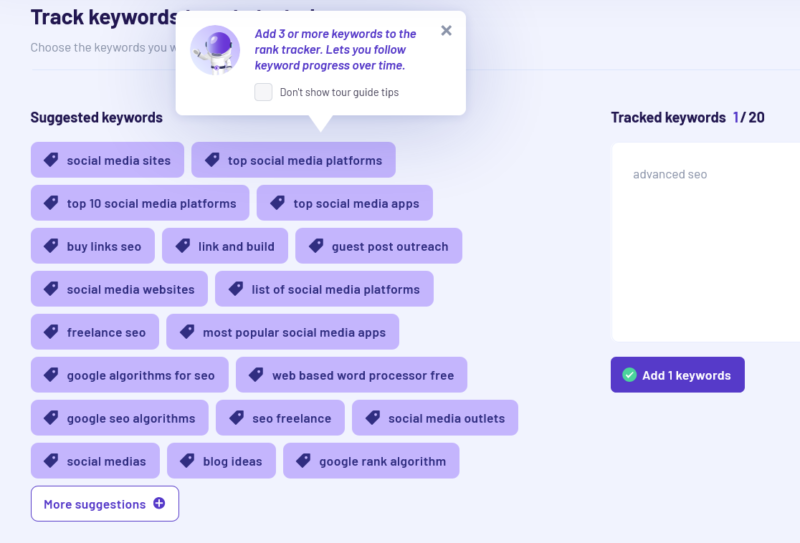
This way you feed two birds with one grain (as a vegan I don’t kill birds):
You get automated keyword research insights from the start and are able to start tracking rankings.
Diagnosing website health issues.
Like most all-in-one SEO tools Morningscore also checks the “website health“.
It’s usually onsite issues within the
- code
- content
- structure.
I found thousands of them for my blog too.
Yet it wasn’t as overwhelming and scary as with other tools. Why?
I was able to find solutions quickly and no bright red alerts glared at me!
After starting my free trial I got a mail message with some of the issues:
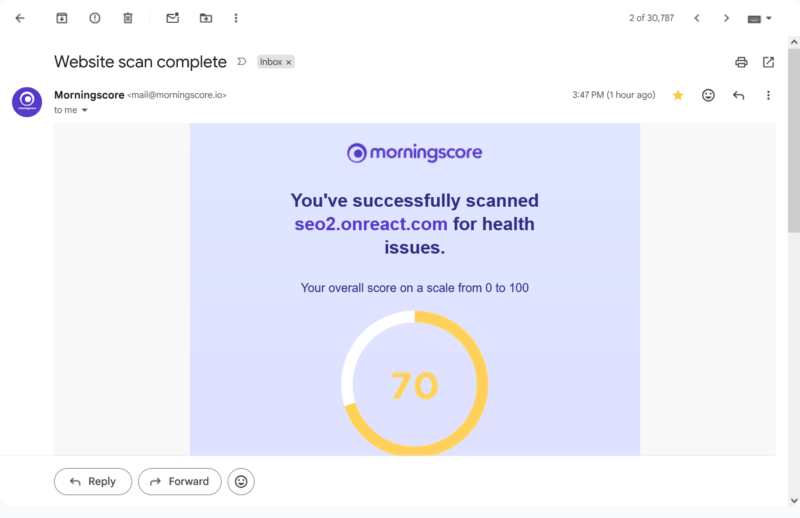
As you see my score is not that bad, especially compared to the other metrics the competing tools provided.
It seems Morningscore is more optimistic.
Yet it’s rather how the score works. It’s an overall assessment.
It includes all aspects of SEO, both on and offsite.
In contrast the other tools mainly measure authority as judged by number and importance of backlinks.
Here we can a run quick analysis of the content as well.
This is my mail issue report below:
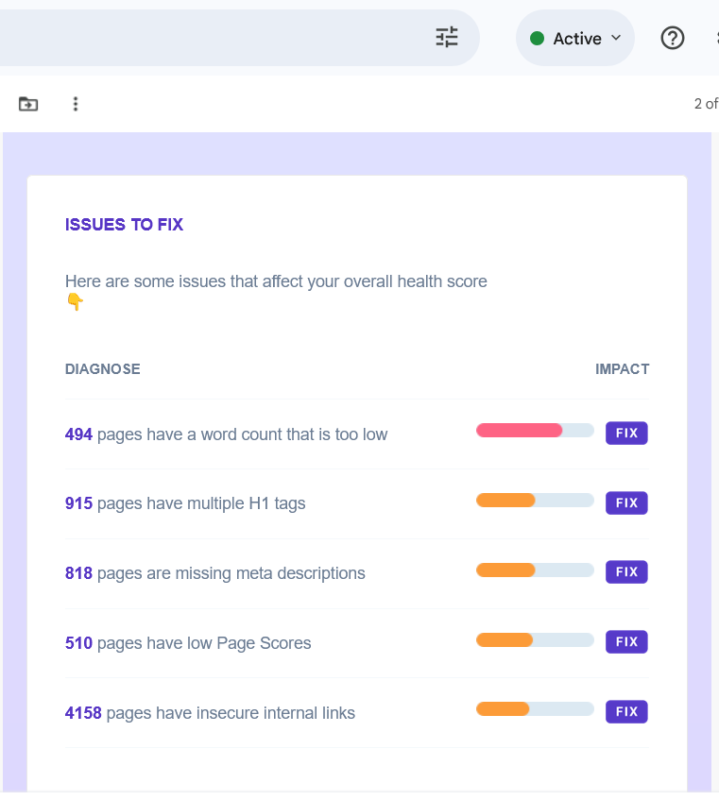
It sounds scary too at first glance.
Especially the last item says “insecure” and that’s huge number!
So of course I checked it out as the first one.
The red issue saying “word count too low” is negligible in contrast for me. It’s pagination and categories IMHO.
Here is what I saw when I clicked on the “insecure internal links” report:
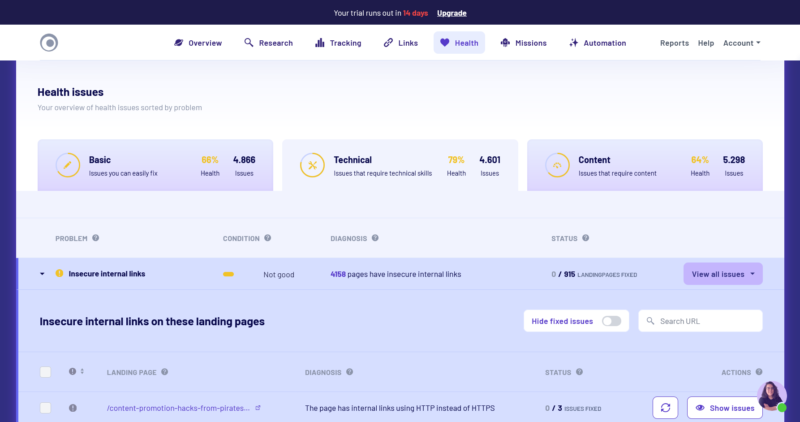
Then I clicked a few of the numerous pages affected and listed.
And what did I find? It’s just three links that cause most of the trouble!
I recognized it right away looking at the insight shared then:
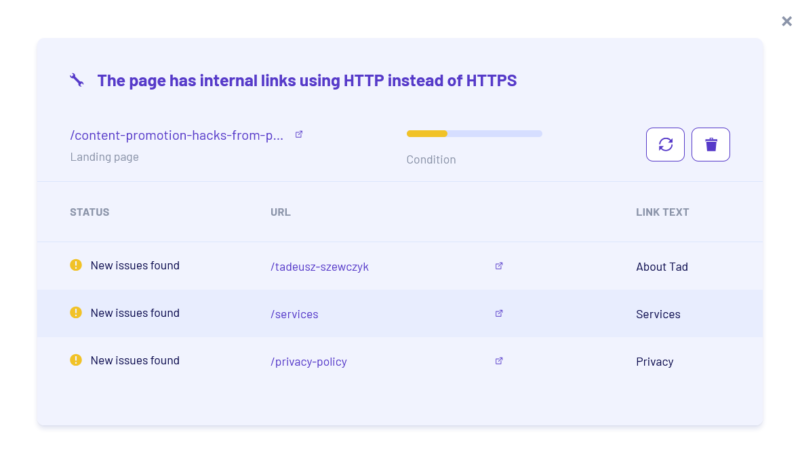
So what happened here? When moving from http to secure https I forgot to fix the menu that shows on all blog articles!
I only changed the links to https on my blog homepage. Yet the theme has two places you have to adjust the top navigation at.
So the scary number of thousands “insecure” links turned far less critical than expected. Phew!
Thank you Morningscore for the insight!
Missions
Missions are probably the most unique selling proposition (USP) of Morningscore.
Usually it’s hard to even assess the importance of each SEO task.
Many tools attempt this by showing priorities in red, orange or yellow.
Yet it’s often also difficult to know where to start or how to go on once you have identified the issues.
You may see lots of color coded issues on your todo list at once.
With missions you get guided through some of the most important SEO processes like connecting Google Search Console e.g.
Below each tab, e.g. the rank tracker, you see a button asking you to “set up missions”. There it says “keyword missions”.
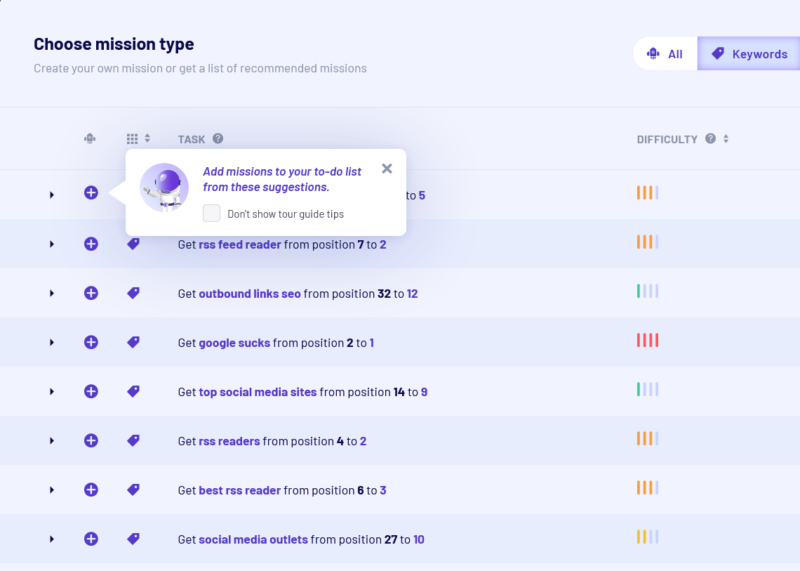
As you see in the screenshot above they are also color coded based on difficulty.
The green ones are obviously the easiest.
Yet there are other types of assessment as well: the mission points (XP) and the ROI (Return on Investment).
The ROI of all the above is “epic” for example.
The points vary on difficulty level.
Based on the up to five colorful bars you get 5 for the most difficult one in red and 2 for the green ones.
That way you can easily find out which missions are best for you.
As an SEO pro I quickly recognized the low hanging fruit.
Yet as a beginner you may need that level of assistance.
For example my existing ranking for [google search algorithm] at #11 is clearly one.
Hence Morningscore suggests it:
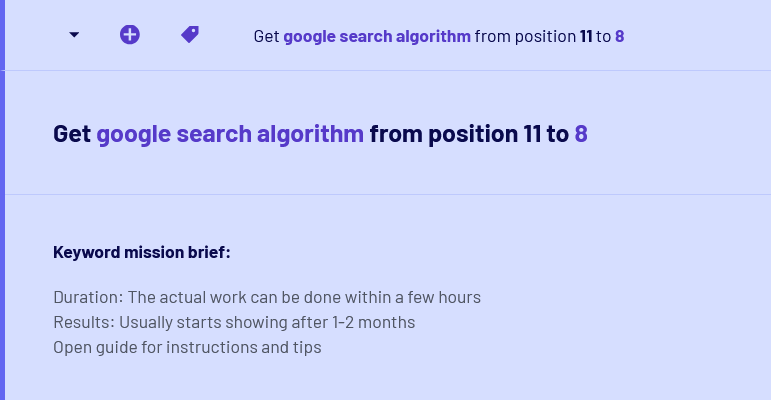
I’ve written a simple guide on the google algorithm back in 2023 and updated it ever since.
So it just takes a little push to make it rank on the first page I guess.
Another update or expanding it a bit more may help for example.
Let’s see what the tool suggests though: Morningscore literally creates an easy to digest 8 step “mission guide” on click.
It opens in a new tab and provides clear step by step instructions:
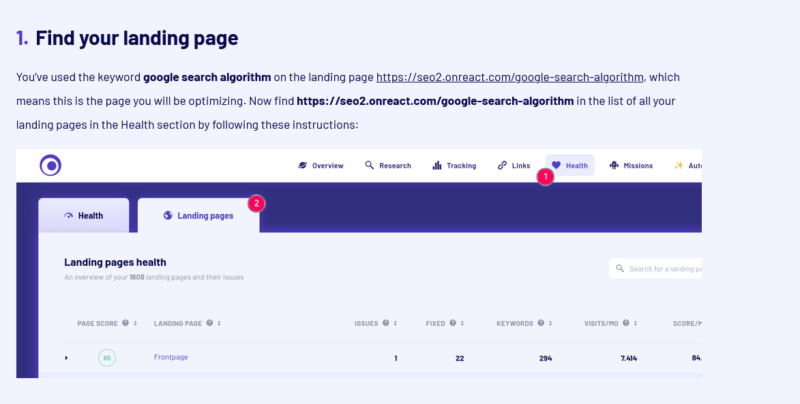
Then you can go back to the main interface to click the “add mission” button to your todo list to save it for later.
When I click the “missions” menu item in the top nav of the app I see it added at the end of the list of recommended ones.
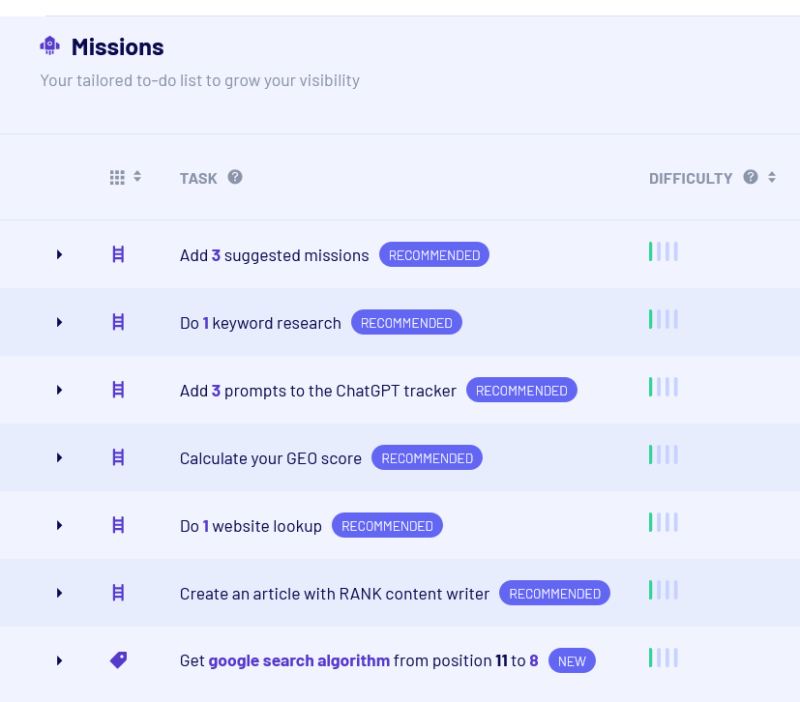
I can’t recreate the whole process here yet you get the point!
It’s easy, it’s fun, it’s DIY SEO at its best.
Is Morningscore really the best affordable SEO software for small business?
I have tested numerous SEO tools over the more than two decades of my SEO practice.
Some affordable ones were among them recently.
What about Neil Patel’s Ubersuggest for example I covered elsewhere on the blog already?
Of course “best” is always subjective. What’s best for me can be subpar for you.
I have been using Ubersuggest for some basic keyword research and rank tracking tasks.
It’s helpful for sure and less cluttered than the big players. The pricing is reasonable. Yet
Morningscore is a whole new level.
The ease of use, the way it presents insights and helps you fix them is unmatched IMHO.
Even in the AI age where people claim to have replaced their SEO teams with chatbots this is a down-to-earth middle-ground between otherwise too risky automation and human oversight.
Morningscore just offers a 14 day trial.
That’s the single biggest caveat.
There are no free features or tools without signing up.
That’s why it might not be one of the best tools for bloggers or freelancers like me who can’t pay for too many subscriptions due to erratic cash flow.
As a small business owner with recurring revenue streams you are likely to be best served with Morningscore though.
It’s subscription based like the big players but offers almost the same features for far less money.
Plus it manages to help where others merely confuse.
When you can’t afford a monthly retainer type of SEO vendor you may be able to improve your online visibility in a DIY way.
This SEO software is way more affordable in comparison.
Morningscore also shows itself how small business SEO can work in an article on their site.
They also have case studies from successful businesses they helped.

This one SaaS company called fenerum performed particularly well IMHO and increased traffic by 500% in just 4 months.
Enterprise clients with whole marketing teams and SEO agencies might still prefer Semrush or Ahrefs.
I won’t stop using all the other tools occasionally.
Yet Morningscore helped me fix some issues I didn’t even realize existed despite checking with various other tools.
I wanted to recommend it anyway. I tested it in 2023 the last time so I reached out to be able to test it again.
This time I got extended access beyond the trial due to my vacation plans.
And I got paid for this article here after I pitched them.
So I may be biased. Thus I just advise you to test run it yourself. You won’t be disappointed IMHO.
Related posts:
WTF is "Parasite SEO"? Is SEO Really "Ruining the Internet"?
What the Heaven is Paradise SEO? The Garden Eden of Natural Links
SEO is Alive! Celebrate with an Online Presence Consultation!
Why SEO is Dead Serious: Google Hates Humor! #seohorrorstories
Why GEO Can't Replace SEO
Your "Crawled – Currently Not Indexed" Message is not about SEO!
Social SEO Metrics to Use Instead of Website Traffic
How Do "Stay on Google" Searches Impact SEO?
In SEO Trust Matters: How to Build it then?