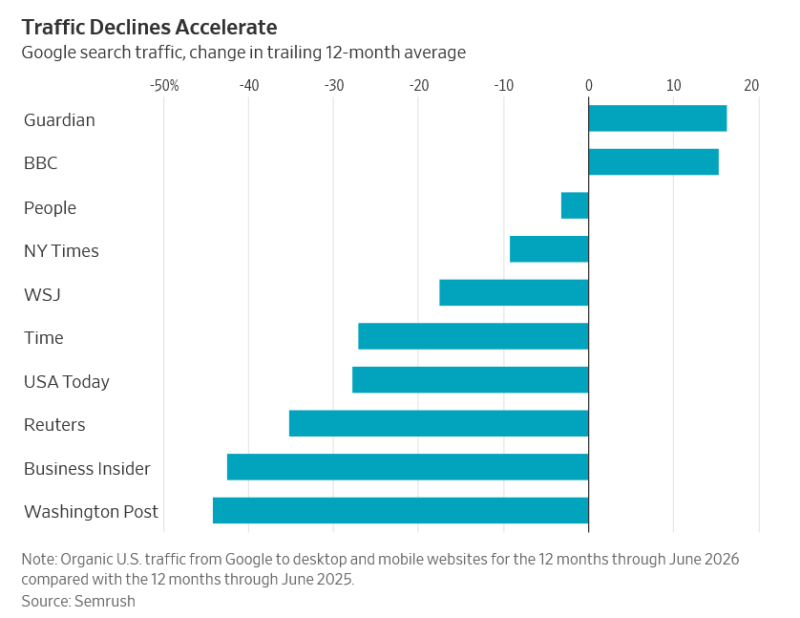
As of 2026 publishers struggle to maintain a steady influx of Google traffic.
Organic search traffic numbers dropped to most large news sources including
- Time
- USA Today
- The Washington Post.
It’s so bad many large publishers consider banning Google search bots altogether according to The WSJ.
Likewise social media algorithms prevent users from reaching publisher sites.
Publishers lose traffic to both gatekeepers Google and Facebook.
Why? Both keep visitors on site using various algorithmic means, by tweaking the interfaces, and by using AI.
Yet social media also get used as “search everywhere” tools.
What happened during the social media heydays?
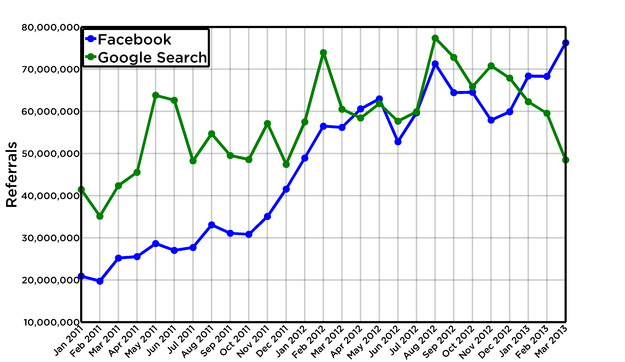
With a short interlude search traffic has been the most important traffic source to publishers for decades.
During the peak of the social media boom sites like Facebook were the number one traffic source though.
Back in 2013 BuzzFeed reported that search traffic was outnumbered by social media as a referral source.
“Traffic from Google to digital publishers dropped 30% over the past eight months.”
The 2013 publisher traffic report was based on statistics from over 200 major media properties, among them
- BuzzFeed
- Time
- Huffington Post
- Rolling Stone
- Sports Illustrated
Overall social media traffic to publishers, even Facebook traffic by itself was bigger than Google search traffic.
Danny Sullivan stepped right in claiming that it’s all so called “not provided” traffic that doesn’t get shown.
That’s not true though. That’s only a small fraction.
Where did all the search traffic go then? I’ll explain.
The reasons are below. Take note though that search traffic outgrew social media traffic in 2017 back again.
So we’re dealing with a much different landscape by now.
Where does the search traffic end up instead nowadays?
Why search traffic drops even despite consistent rankings
So by 2026 many publishers experience traffic declines for various reasons.
Yet many of them are common for websites of all kinds.
Let’s mention the most important ones.
AI summaries take space on top
With the introduction of AI Overviews and later AI Mode people do not need to click results anymore.
They can read a summary on Google search itself.
Other search engines have similar features removing the incentive to click through to sources.
Google Knowledge Graph
The so called Google Knowledge Graph is designed to keep searchers on Google.
Long before AI it gave them all the information they need onsite or send them over to similar search pages.
Searchers do not need to click actual search results anymore.
For example Google scrapes content from Wikipedia and displays it right in the results.
Google Image Search content theft
Google Image Search has been overhauled to obfuscate sources.
The current version steals your images and displays them on Google without prominent ways to click through.
There is no way to redirect the searcher to the image source anymore with frame-breakers or similar means.
Advanced hotlink protection can help to recover some clicks partly but can’t stop Google from this large scale content theft.
Google also introduced the image mismatch penalty to prevent copyright holders from overlying images with calls to action.
Paid search “results” above the fold
For many search queries, especially those that make money Google doesn’t display real search results right away anymore.
Instead you’ll only see ads and hidden ads that is “paid inclusion” Google services.
Ads are often referred to as “sponsored results” and the note is only visible on top.
It’s hard to spot where the ads actually end and organic results even begin.
You have to scroll to see some actual organic search results.
Many people click what’s on top instead and often do not even notice or care whether it’s an ad or not.
Social media dwell time grows, search dwindles
For a few years in a row the so called dwell time on social media sites has grown while the one on search and Google dwindled.
Dwell time is the actual time you stay onsite and use it.
Users spend hours on Facebook or YouTube per week while they search only for minutes.
Just think of it: When you use Google it’s just the intermediary not the final destination.
That’s why Google tries desperately to push their own products and services.
By 2026 it even grabs third party content to make people stay on site.
People visit sites directly
When I searched for [seo] I’ve seen almost the same entry level search results for many years in a row.
- Wikipedia
- Google’s own “SEO Starter Guide”
- some “what is SEO” primers for beginners
When I search for something new on the topic I use other sources.
X/Twitter is still a good place to find the latest trends and content.
I check what my social media friends share. Thus using search is only for first time users in many cases.
Once you know where you want to go, you can go directly.
I can check out
- the Semrush blog
- Search Engine Land
- or Search Engine Journal
without the help of Google.
Also I follow Barry Schwartz all over social media so I get the search industry coverage in any case without searching for it.
Some traffic gets wrongly attributed
Google hides most of so called referral data from publishers.
Web analytics tools show you who came from search to your site e.g.
Yet Google does not show what people searched for unless you use Google’s proprietary tools to find out.
You have to check Google Search Console to see some keywords.
Publishers have to buy ads on Google to see keyword data. That called “privacy” in Google’s Newspeak.
Given that some people use “do not track” directives they won’t display on Google tools at all.
With AI search it’s even worse.
It’s hard to tell what people search for and how many click through as of 2026 even using GSC.
Answers instead of search results
What’s the overall trend here?
Google tries to become a destination itself.
The gatekeeper is closing the gate more often so that fewer searchers can go though.
Modern search is about answers not search results. Google is not a search engine it’s an answering machine these days.
For businesses it’s just a toll-booth. You have to pay the gatekeeper to get let inside the increasingly walled garden.
It’s no wonder that Google traffic dwindles.
Their long term goal is to keep users on Google and grab as much third party content as possible.
When it comes to mobile interfaces or images the process is already very painful to publishers.
Social media also replaces search for many people.
You rather trust your friends than a buggy Google algorithm.
Where did all the search traffic go?
Most of it didn’t go anywhere, it stayed on Google.
By 2026 around two thirds of searchers do not click through.
Many moved to social media or even dark social you can’t attribute.
As of 2025 social media was responsible for generating around 10% of global traffic.
AI amounts still for only a tiny share of overall traffic.
Related posts:
The Google Search Algorithm Explained in a Nutshell
Where to Buy Links? How to Get Link Juice? Do Follow SEO Advice!
How Do "Stay on Google" Searches Impact SEO?
Social SEO Metrics to Use Instead of Website Traffic
SEO Works! How? Step by Step + Project Examples
Why Facebook Can’t Replace Your Website and How to Use it for Business
What the Heaven is Paradise SEO? The Garden Eden of Natural Links
Why GEO Can't Replace SEO
Is This the Best Affordable Semrush + Ahrefs Alternative for Small Business?