
Good old Facebook is still the leading social network online!
Many people — even business people — rely on it for their online presence.
Is this a good idea? Not really!
Here’s why Facebook can’t replace your website.
Plus some ways to use Facebook for business that still work.
Does Facebook still matter in 2026?
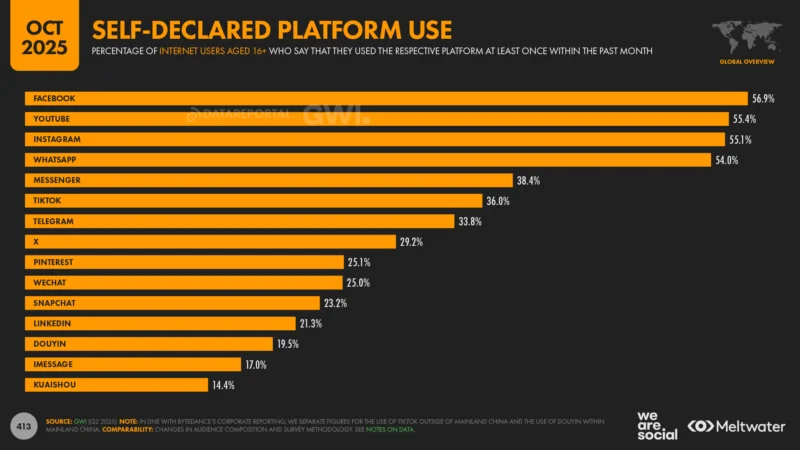
Yes! Facebook still matters! Even in 2026 it’s still on top!
Despite all the criticisms and “delete Facebook” campaigns Mark Zuckerberg’s first social site still reigns.
- Facebook is one of the two biggest social media along with YouTube data published by we are social/Meltwater shows.
- It’s also one of the three most popular websites in the world by sheer traffic as measured by Semrush!
- It is still the number one social media traffic source with around 70% market share according to Statcounter.
The others are negligible in contrast! Pinterest — number two for many years — is just an also ran by now.
So whether you like it or not you still have to consider Facebook when spreading the word and improving online visibility.
Why Facebook is not a good website replacement
Why not just be on Facebook and save money on a separate website then?
It’s not advisable. Use Facebook as a nice to have addition not a replacement!
There are many reasons not to rely on Facebook for your online presence. I complied a list of them. See below!
Being on Facebook is not being online
Yes, many Facebook users do not even have a website or completely neglect the one they have. Why?
- Some can’t afford a website or content creation and promotion.
- Others use Facebook out of habit or because it’s easier to update.
- For many freelancers it’s enough to spread the word along with other social channels.
Facebook allowed hundreds of millions of people who didn’t have the opportunity to build a website to publish online.
On the other hand Facebook is not the Internet, it’s just a so called “walled garden” type of service.
When you’re on Facebook you are not really online, you are rather on Facebook itself.
Even most public content requires a sign in to Facebook to be viewed.
Without public access Facebook can’t replace a blog.
When you visit my public profile on Facebook you only see the latest photos but not my updates!
Facebook owns you
In the early years of Facebook’s rise to domination of the social media space it was very promising.
Especially after the demise of Friendster and the decline of MySpace the site was a boon for publishers.
Many pundits even argued that you don’t even need a blog anymore — the hitherto standard ways to get heard online.
For a while they had the stats on their side. Facebook traffic to publishers overtook the one from Google search.
One day Facebook started to throttle so called “organic reach” to make you pay to reach your actual audience.
What does this mean? Only a small fraction of your Facebook followers will see your updates ever since.
To reach more of them you need to buy Facebook ads.
It’s like paying a company to be able to talk to your family and friends!
Facebook is — along with Google and Apple — one of the largest and most powerful gatekeepers on the Web now.
They control access and traffic on their proprietary turf. It’s like in the middle ages. You need to pay to enter the walled garden.
You get protected against many of the dangers of the open Web but your just a visitor, not the owner of the place.
Facebook owns your profile, page and even connections.
You can’t even quit Facebook permanently.
When you delete your account it will just be hidden from (your) view but they still retain the data. They basically own you.
Facebook is not really free — you pay in manifold ways
You could argue that Facebook is free — as in free beer.
You are paying with your private information and content you share as an average user. Facebook sells it to advertisers.
You pay with your attention in the advertising funded “free” version.
Of course the government loves that data as well.
Government agents can view your images, opinions and messages you shared privately whenever they want. Why?
It’s according to US law (think Patriot Act) which applies to ALL Facebook users globally.
From a business perspective you might ignore the privacy (or rather lack there-of) implications of using Facebook.
After all you use it to make money — don’t you — not to plan terrorist attacks or show off naked photos of yourself.
Yet when it comes to renting space online you can’t ignore the fact that you are not owning your Facebook page, profile or data.
You have to abide by Facebook’s rules and even adapt to their numerous layout changes.
Facebook is fickle
Last but not least Facebook — again like Google — frequently changes its algorithm.
Recent changes have for example hurt publishers and businesses in favor of regular users.
What does this mean exactly?
People are less and less likely to even see your updates on Facebook.
Compare this state of affairs to a blog — a website you own and publish regular updates on.
Ideally you also have a way to reach your audience by mail.
You can use a freemium tools like Klaviyo to send regular updates to subscribers.
Yet you also can send mail from within WordPress yourself using some third party extensions. In short
you don’t have to pay each time to reach an audience or hope some tiny part of it will miraculously view your updates.
You can send mail messages to your actual subscribers and reach a large portion of them.
It of course depends how you convinced them to subscribe and how valuable your messages are but it’s a far better.
How to use for Facebook for business without getting lost?
OK, so Facebook has a huge audience even in 2026 and it can still send traffic to websites.
Yet to show up with regular updates you need to pay a lot for ads and might end up attracting the wrong audience.
Believe me! I worked as a social media manager for large Facebook Pages.
One of them got so many angry comments from people who viewed the ads that it was my main task to deal with those. Why?
My client offered free websites yet their updates got pushed to Web designers who competed with them!
There are other options to get the word out about you on Facebook. Here they are!
Facebook Messenger
Facebook Messenger is a standalone instant messaging tool like WhatsApp (also owned by Mark Zuckerberg’s Meta) or Telegram.
It is also embedded on Facebook itself so you can use it from within the site.
It’s easy to connect and send messages to your friends that way.
For Pages it’s more difficult yet you need a profile as well anyway to run a Page.
You can get contacted easily by way Messenger when you run a Facebook page. I often do when a company website has a bug.
People who appreciate you already and follow or befriend you are more likely to accept messages from you.
Once they do you can notify them about your latest events e.g.
Facebook Events
Facebook also offers dedicated event calendar and feature.
When you mark and event as “interested” or “going” Facebook will remind you of it.
FB also tells your friends and followers about the events you signed up for so that more people can attend them.
You can notify your friends and followers each time you create an event. There is literally a feature shown for it.
It’s called “invite”. Then the event shows up in your events once you look them up. I regularly do. So it works!
Events also show up in a few places once the date they happen is near.
Facebook Groups
There are often huge semi-private Facebook Groups for almost all topics you can imagine.
For example I am huge fan of the Ecstatic Dance Berlin community on Facebook.
It has like 15k members. They rarely interact with the group content but I check it regularly for events.
There are other groups that focus more on engagement and debates. You can get huge traffic spikes from those.
Some groups have millions of members from over the world.
Yet the few people who attend your event you announce in a relevant group are preferable IMHO.
Do you feed the “king of content”?
Don’t get stuck in the castle of the king of content.
Publish your content on your own terms to your own faithful audience you control the access to.
Then nobody can demand ransom from you to allow you to speak to your loved ones.
Facebook is a neat tool for small talk with friends and family who are living far away so that you rarely meet in person.
It’s not a business strategy to rely on Facebook for getting clients though.
It’s rather a recipe for dependency.
Post short updates on Facebook if you want. Use
- Messenger
- Events
- Groups!
Yet always remember that it’s a tool to popularize your own content that resides on your blog or static website.
Also it’s not your task to create free content for a billionaire all the time.
Make sure that Facebook users can share and likes your articles, images or videos.
Don’t give away ownership of your content assets to a young billionaire who already has more than enough money.
Let others promote you on Facebook.
Each time someone is “interested” in your event or comments on an update the algorithm shows it!
Don’t pay a gatekeeper to access to an audience you can build yourself on a website that is really yours!
It’s also accessible for everybody not just Facebook members.
Your website should be your castle
Sure, Facebook is huge and provides you with a potentially massive audience.
Especially in the rare case when your content manages to spread virally.
Your website should be your castle, though. You own it.
When content gets popular on Facebook, Facebook gets popular at the end of the day, not you.
When you use Facebook to send visitors to your website your popularity will remain even when Facebook deletes your page.
You decide what’s the topic of your website and you don’t compete with Kim Kardashian’s behind for attention there.
Everybody can view content on your website. Facebook requires a membership and a log in.
You can create our own look and feel and have your own brand identity instead of the Facebook blue and clutter.
Its numerous often redundant user interface elements are really distracting!
That’s probably the scary part: you can do anything you want on your site and you’re responsible – nobody else.
Nobody can ban you or demote your updates.
Some people prefer the confines of a rigid system like Facebook.
These are the same people who prefer to have a boss that tells them what to do.
On your website you decide everything yourself.
So much choice may be overwhelming but as a business person you need one skill: decision making.
Start training your decision making muscle with your website and you will thrive as a business owner as well.
This post of mine originally appeared as a guest post on another blog that went defunct by now.
At the end of 2025 I updated, expanded and rewrote it for seo2.blog