 *
*
Are you spitting rhymes about gold chains and Adidas kicks?
Or shaping your SEO and content strategy?
One thing is for sure and essential… “Keepin’ it fresh.”
Fresh content is current and engaging, and Google prefers that.
It seems nowadays the Google team wants your website to keep content as fresh as organic veggies!
How do you do that? Let us find out below together! It’s tricky, tricky, tr, tr, tr, tricky!
The Google time machine
When Google checks how current a piece of content is they use a time machine!
How is that possible?
We know since 2011 that Google has an algorithm for assessing content freshness.
Back in 2012 they also filed a patent that clearly described the process behind it.
It’s tricky!
Over the years it has become more and more apparent that just changing a date on a published post is not enough.
Google’s search advocate John Mueller has repeatedly stated that a content update needs to be significant or substantial:
“If an article has been substantially changed, it can make sense to give it a fresh date and time.”
Yet he also cautions not to change the date on a whim:
“However, don’t artificially freshen a story without adding significant information or some other compelling reason for the freshening.”
What was a relatively stable way of doing things is now totally flip flopped.
SEO-savvy marketers are constantly keeping one eye on the Google algorithm.
So it’s a good idea to revisit the algorithm for Google content freshness or QDF (Query Deserves Freshness).
In the above mentioned patent Google also explains that
- it saves the whole document history.
- It counts how often a document gets updated.
- It notices and considers traffic spikes.
- It looks at incoming and outgoing links.
- It checks wording for new terms, even when it comes to anchor texts.
Thus search engine optimizers must focus on
- updating existing content
- expanding content by adding more insights, media or view points
As the landscape continues to shift one thing is for certain, Google doesn’t like low quality material.
A mass strategy to publish and disseminate as many pages as possible won’t work anymore due to the AI slop flood.
Google now uses a systematic approach to index and push only high quality material.
You may see Google Search Console telling you that a large amount of pages are:
In 2026 it became blatantly apparent for search marketers: non-unique content gets demoted by their algorithms.
Many people started to proclaim, “SEO is dead as usually in such cases.
What are the experts saying?
Truth is, SEO is alive!
It is just more difficult as search engines find better ways to index and understand content.
Here are a few of my favorite takes on our current search engine landscape:
“Maybe the problem isn’t the thin content that users detest seeing in search results. Maybe the problem is with SEO itself.
The purpose of SEO is to achieve top rankings and visibility, maximum impressions and clicks in SERPs”
– Adam Audette
Yet no SEO techniques can replace a great product.
What is a great product?
It’s a site that people want to visit
- return to
- share with their networks
- email their friends
It’s also called attracting links and “buzz” or “word of mouth”.
Get it? Great content and natural links and buzz = the new SEO
– Laura Lippay
So what are the modern SEO rules of engagement:
- Write meaningful posts.
- Help people.
- Solve problems.
- Promote these posts, socially and otherwise.
How important is freshness for Google search?
SEO really isn’t anything to freak out about.
You don’t have to constantly update and refresh all existing content!
SEO best practices really haven’t changed too much despite AI.
The freshness algorithm (QDF) does not affect all of searches in the same way.
Things like
- the weather
- sports scores
- breaking news
are obviously different than
- religious insights
- scientific consensus
- historical facts.
Most business content is somewhere in the middle.
So you may have to update a post once a year or so.
The high level approach may have changed somewhat (emphasis on different SEO techniques like digital PR).
Yet the people who cut corners and use AI to scale content are often the ones crying when Google changes an algorithm.
We all know that!
Even though Google’s algorithm will continue to adjust, quality content and best practices remain relatively stable.
Updating content is a best practice by now
Everybody in SEO seems to agree that Google is rewarding freshness in their search results.
However, Google returns only two sites have been published in the past year for [fresh content seo] (see screen shot below):
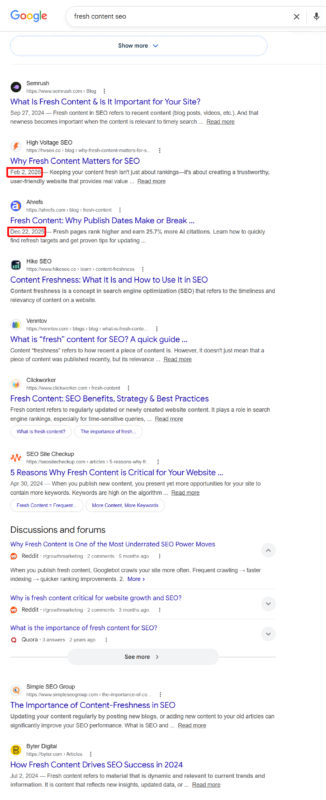
Regardless of this irony, to stay in the safe zone, and continue ranking for search terms on Google you have to adapt!
Ensure your high level approach incorporates
- creating fresh content
- updating existing content when needed.
Focus on solving problems with your content and promoting this on multiple different media and it will be ranking for years.
To differentiate yourself further from the AI slop polluting the Web be unique and very specific on top!
I often do simply by adding a unique take only I could have provided.
This was originally a contribution by Matt Krautstrunk.
By 2026 it has been updated by seo2.blog owner Tad repeatedly.
* Image source: Urb.com
Related posts:
Is This the Best Affordable Semrush + Ahrefs Alternative for Small Business?
Where to Buy Links? How to Get Link Juice? Do Follow SEO Advice!
Your "Crawled – Currently Not Indexed" Message is not about SEO!
SEO is Alive! Celebrate with an Online Presence Consultation!
Suffering from HCU? Holy Cow! Helpful Content System Agony
WTF is "Parasite SEO"? Is SEO Really "Ruining the Internet"?
The 10 Most Obvious Benefits of X/Twitter for Business
How Do "Stay on Google" Searches Impact SEO?
All You Need to Know About Blogging in one Place!