
So you publish online? You may have your own website or manage someone else’s? Then
you probably want to know how to show up on Google search.
You most likely also already use Google Search Console (GSC from now on). Why?
To check whether you site gets properly included and shown on Google.
You need to be in Google’s index to get found.
One of the most common indexing issues on GSC is the “crawled – currently not indexed” message.
In 2026 you may have noticed that the number of “pages” being barred from the index has grown significantly.
Most people assume it’s some type of SEO issue! Yet it’s not!
It’s rather a content issue.
Don’t believe me? Hear me out!
How to read the Google Search Console indexing report?
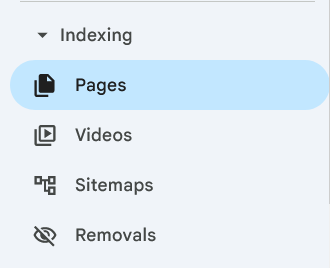
When you use GSC one of the most prominent reports is called “Indexing“.
Indeed it’s the first proper section in the left hand navigation.
It looks like this:
Why is it so significant? Google search can show and rank your pages only when they are part of the index in the first place.
So it’s like the first hurdle to overcome.
In other words only once Google adds you to their index your pages can get ranked and shown to searchers.
Ideally they show on top when they are very helpful and authoritative.
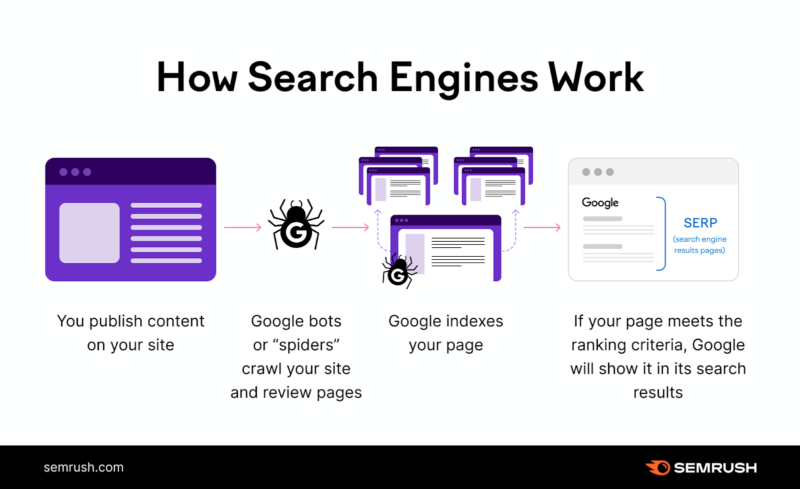
So obviously you have to find out whether you’re part of the index already before taking a look at how you perform.
Yet many if not most pages already fail at that.
They won’t even get indexed. Why?
Getting into the index is harder now
Getting into Google’s search index is much harder nowadays.
You may have checked GSC in 2026 and almost got a heart attack.
You’re not alone!
Many website owners witness this change.
People ask for help on Reddit all the time due to indexing issues!
Heck, indeed the number of not indexed pages from this blog grew rapidly in 2026.
It was like 300 pages in “crawled – currently not indexed” in early 2026.
Now in mid 2026 (as of May 8th) more than 800 “pages” are not indexed:
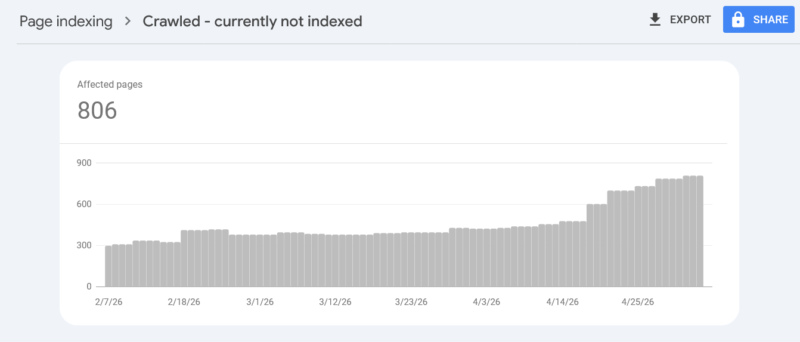
This is the GSC screenshot for this very blog here.
It says “Affected pages 806” as you see.
So what happened?
Google started to be very choosy on what to include in its search index.
Why is that?
Everybody and their friends are using AI to flood the Google index with mass created AI content.
Google refers to it as “scaled content abuse“.
Even if it’s not just AI slop or has been “humanized” Google might frown on it.
Also low quality “human” content gets demoted too.
So just because you wrote it yourself does not mean it deserves to be indexed.
John Mueller on indexing issues: “search is never guaranteed”
Yet this is nothing new really!
Back in 2022 John Mueller — Google’s most prominent search advocate — already stressed this by saying:
“search is never guaranteed”
What did he mean by that? Luckily he elaborated:
“what ultimately works best is that you prove to Google (and users) that the updates you’re providing are valuable”
Plus he even offered a list of factors that make content valuable in Google’s eyes so that it gets indexed properly:
- “unique”
- “compelling”
- “high-quality”
I made a list for readability. He used commas originally.
These insights were ahead of its time to some extent because Google increasingly focuses on these signs now!
Plus consider his last suggestion in this context, it’s basically rewording the “unique” point he mentioned first:
“and not something that’s already published elsewhere.”
So what does this mean?
Google does not want another “me too” type of content piece.
Even if you have written it yourself using unique words!
When there is someone else out there saying the exact same thing you lose.
Then it may be better to just link the original source instead of rehashing it.
In such cases I usually add at least my unique take. Ideally based on first hand experience like in this very article here!
So in 2026 he reiterated that standpoint a few times.
He especially warned not to “force indexing“.
Why “crawled – currently not indexed” is not an SEO issue
Now when people notice that their “pages” are not fully indexed they assume the SEO is to blame.
Yet the specific message “crawled – currently not indexed” or even worse “discovered – currently not indexed” is not about SEO!
At least not in the strict sense most people use the term for these days.
Of course there is a plethora of technical and other SEO issues that may cause a page not to get indexed.
Luckily Google will tell right away you about those!
So when I take a look at my indexing report I see all the technical issues Google encountered already:
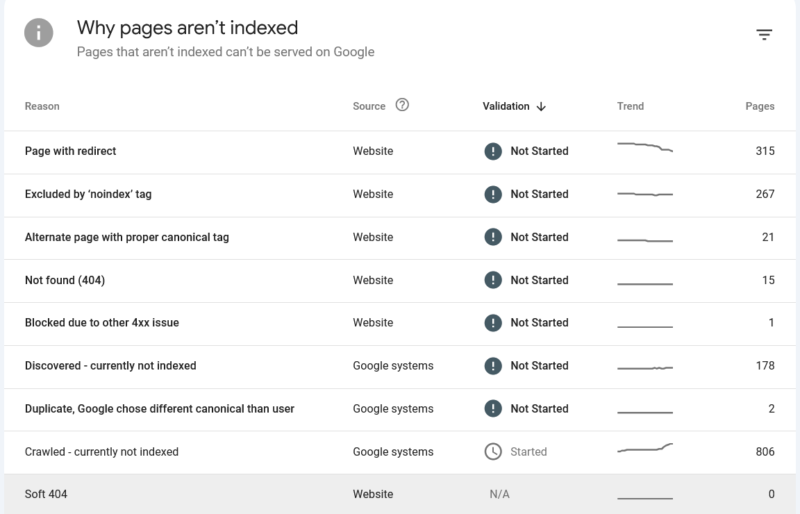
Above you see a screenshot from my own GSC report on
“indexing -> pages -> “Why pages aren’t indexed”.
It seems like there are a lot of technical SEO errors up there!
Isn’t it? No. Most of these are going according to plan.
The best thing about the report is that once you click on it you realize most of them are fine and Google is right! How come?
Let me explain what we see up there and why it’s OK in my case!
Let’s take the biggest example on top:
Page with redirect
When you change a page’s content so much that even the headline and title do not fit anymore it’s also time to fix its name.
Then a change of address is advisable. Ideally you don’t change websites addresses or URLs.
Yet given that this blog is almost 20 years old and that I update the content repeatedly over the years sometimes you have to.
Otherwise the address or post “slug” might be misleading by now.
So when you change it WordPress either automatically redirects to the new one using a so-called 301.
Or you have to enter it manually using a tool. WordPress has plugins for that!
I do both on a case to case basis. Ideally the old URL still works that way and visitors clicking on it end up on the page (or post).
So Google does not want to index the old version anymore obviously!
They just want the new and current one, the one you updated recently. So that’s probably it.
315 pages may have a redirect like that and still had a former version of them in the index.
The old stale versions of the pages have been removed from the index! Yay!
Looking at the report I found mostly other reasons for dropping out of the index though.
It’s mostly images that have been de-indexed.
I did it on purpose when I disabled the image sitemap on Yoast SEO.
Why? Other people would just see the images without context.
Yet I didn’t want that!
I could explain the other “issues” as well but in this article I rather want to focus on “crawled – currently not indexed”!
Fix your content to get into the index!
So what is the actual problem when a large number of pages are “crawled – currently not indexed”?
Sorry to say that but
- either your content sucks
- or nobody knows you yet!
Most people don’t want to hear it as they feel offended and their ego takes a hit.
Instead they rather try to force Google to index their content.
There is a whole bunch of more or less shady “indexer tools”.
Indexer tools will use manifold tricks to submit or re-submit your pages to Google.
As it’s not a technical issue and Google decided on purpose not to index them you might even get banned for that!
So you need to fix your content instead! How?
E-E-A-T
Add some proof of first hand experience, expertise, authority and signs of trust to it or in short E-E-A-T:
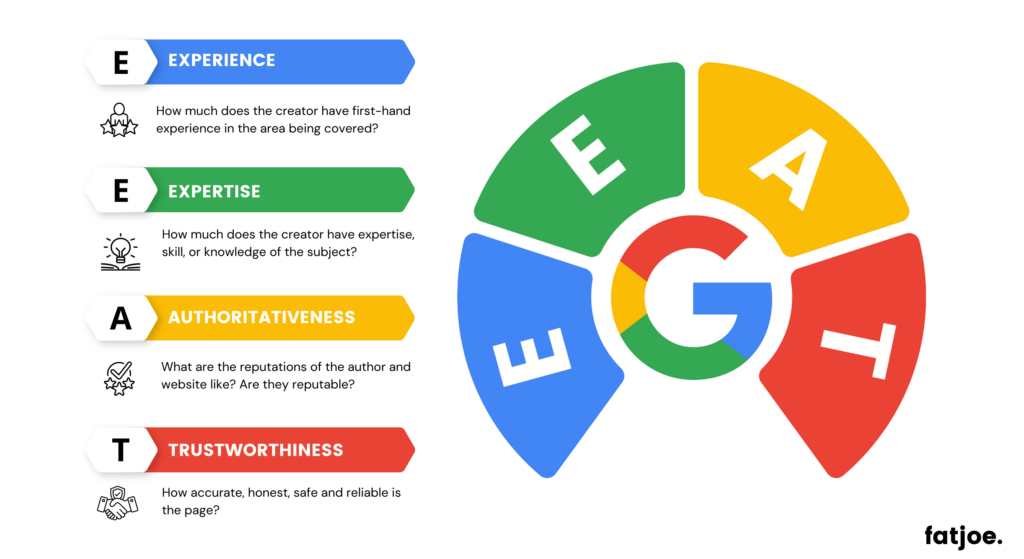
Real life photos (experience), certifications (doctorate as a doctor e.g.), industry appearances elsewhere, and other badges of trust.
Many sites still publish content anonymously without a proper about page, author names or credentials.
Make E-E-A-T a priority from the start!
Gabriella Sannino summarized it quite aptly on LinkedIn:
“E-E-A-T is a holistic framework, not a checkbox.
How is Google meant to know that you’re an authority in your industry when even visitors can’t see it?
Make sure actual human authors show up with photos and credentials.
Ideally you see them on each page or post they have written not just the about page.
Incoming links
Ideally other sites directly link to your actual content pages (not just the homepage or about page).
In the best case the content you publish is so unique that many others refer to it both on social media and their own sites.
Add unique data from your own surveys e.g.
So called editorial links are the best option here.
When you can convince the press to write about your content you will most likely succeed at getting that context indexed.
Tools like HARO (Help a Reporter Out) even welcome you as a source!
Content updates
Even of your content is great and has been ranking in the past does not mean it will stay that way forever.
When you let your content rot for years without updating it Google may sooner or later de-index it completely.
In the meantime much better and comprehensive content has been published on the same topic elsewhere in most cases.
Plus you may have even a post on your own site that covers something similar so that Google only chooses the more recent one.
Ensure your content gets refreshed regularly.
Ideally expand it by adding more
- expert insights
- rich media like (images, audio, video)
- or links to additional resources.
Google has a whole set of routines to check for that. Changing the date won’t be enough!
Some example “crawled – currently not indexed” pages from seo2.blog
As mentioned above I have by now 806 “crawled – currently not indexed” pages according to GSC.
That’s like 500 more than three months ago!
Yes this seo2.blog has the same issue almost everybody else has.
You could claim that I also suck at SEO.
So I decided to check them out to make sure nothing valuable gets de-indexed.
So I took a look at my own report. See a screenshot of the top 10 pages affected below:
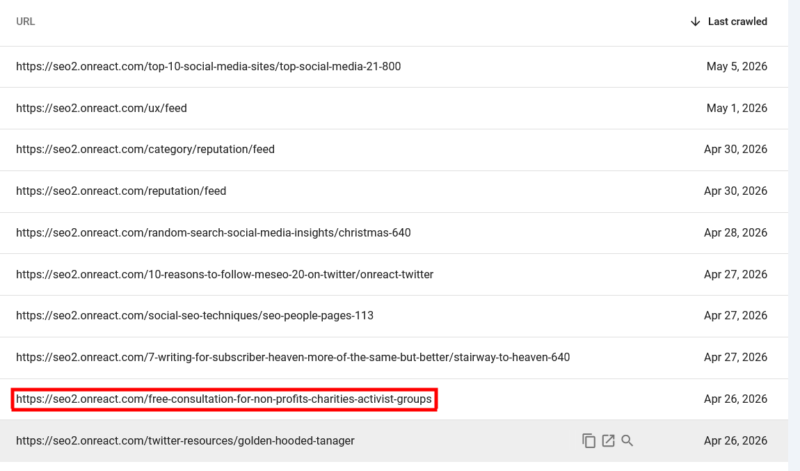
Images
As mentioned above already most of them are image “pages”.
I don’t want to have them separately in the index anyway.
Instead I want people to find the images on the actual article.
Feeds
There are a lot of feed pages there as well.
What er feed pages? You can use so called RSS feeds to follow blogs.
WordPress blogs create an RSS feed out of the box.
It’s like one of the defining characteristics of a blog!
Yet you can also subscribe to individual post feeds!
As I have disabled comments here anyway there is no reason to keep those!
Feed pages are just duplicates and have the wrong format (RSS).
Posts
There is just one actual post in the first ten.
It’s marked in bright red in the screenshot above.
It’s about me offering a free consultation to non-profits etc.
So what happened there?
- The post hasn’t been updated in almost 3 years.
- There are no outgoing links.
- It’s solely self-promotional in a way.
- And I haven’t shared it or linked to it in years.
- I also have a better post on non-profit SEO.
So it got off the radar! Why should Google index it if I have stopped caring?
So what can I do?
I will probably
- link prominently to it on my about page.
- share it on social media
- update and expand it
- mention examples of non-profits I support and link to them
- interlink my other non-profit SEO post with it.
I’ve also tested some of the measures with another post that was crawled – currently not indexed.
It’s the one about Google’s ex-CEO Schmidt and the predictions he made years ago.
Why? It’s probably because I haven’t updated the post in almost a decade!
- First I updated and expanded the post.
- Then the new date made it show on top of my blog homepage (as I do this automatically).
- I shared it on LinkedIn using a new angle or the common question whether Google lies to us.
The three measures haven’t helped to get it back into the index. I’m afraid the information is just not unique enough.
So I might have to rewrite it to use a more current angle to get it relevant again.
Still testing the waters here so stay tuned.
I might follow up with the results or lack there-of here or in a new post!
Technical SEO vs content SEO
By now most people mean by SEO what experts like to call “technical SEO“.
Yet in my opinion at least most SEO is about content and socializing (hence SEO2).
Without content even the best optimized empty site won’t rank.
And even with lots of content a site nobody refers to (by linking to it) has no real authority.
You may claim that you’re an expert but as long as nobody else says so Google won’t believe you.
Thus you have to socialize with people who can then recommend your work in a way.
When you don’t tell anyone they won’t discover you most likely.
I’d like to call this process social SEO.
Yet this post is obviously more about content SEO.
That way the “crawled – currently not indexed” issue is about SEO actually.
I exaggerated a bit to make a point though.
There are some “technical” SEO issues left that may cause a surge in your “crawled – currently not indexed” numbers.
It’s not that the crawler couldn’t access or something!
“It means Google’s crawler visited your page but decided not to add it to the search index.”
Olga Zarr
Yet by 2026 it’s most likely low quality, unoriginal or “thin content”, especially when you use AI.
How to create content worthy of being indexed?
Focus on your unique perspective and describe it as best as possible.
Adding lots of details certainly helps.
I’ve done both of the above.
Of course you still have to at least mention the consensus.
Just being contrarian or controversial will get you the outsider label and demoted too.
By 2026 Google distinguishes between “commodity content” (bad) and “non-commodity content” (good).
Commodity content is highly generic and superficial.
Non-commodity content is very unique and specific.
“We have moved past the era of content volume. The algorithms are aggressively filtering out the echo chamber”
Gill Pawan
So what is the single original contribution you can make nobody else has?
That way much content is redundant in a way. It’s often extremely hard to be 100% one of a kind.
Yet you can provide a peace of the puzzle nobody else has.
It also reminds me of the popular parable about blind men explaining what an elephant is.
Each one of them just touches a part.
- The leg is like a tree.
- The trunk is a like snake.
- The tusk is like a spear.
So which part of the elephant are you touching?
You don’t always have to describe the whole elephant nowadays.
Just find the one part nobody else is touching yet or most ignore.
Do you need help?
So as you see nobody is exempt from the new Google policy to only index the most valuable content!
Even someone like me with 20+ experience in SEO and a rock-solid authority domain faces this.
Are you are struggling with most of your content being not in the index?
- You can reach out by mail (onreact at gmail.com e.g) or via social media.
- I’m @onreact everywhere but LinkedIn is the best way to reach me for work.
I may be able to help you updating and improving your content so it’s valuable enough for the Google index.