
*
Are you publishing blog posts? And doing everything “right”? Yet the results aren’t there?
You might be missing search intent.
When creating a product or service, most businesses think about their audience. What they need, what they like and dislike…
Yet that’s not usually what happens with blogging.
What’s wrong with typical business blogging?
Read on to find out!
How average business blogging for SEO fails
People blog for all the wrong reasons:
- to cover some keywords
- rank well
- outrank their competitors
and other purely SEO-related things.
The problem here is that businesses often forget who they blog for.
That’s why some Google users feel like this:
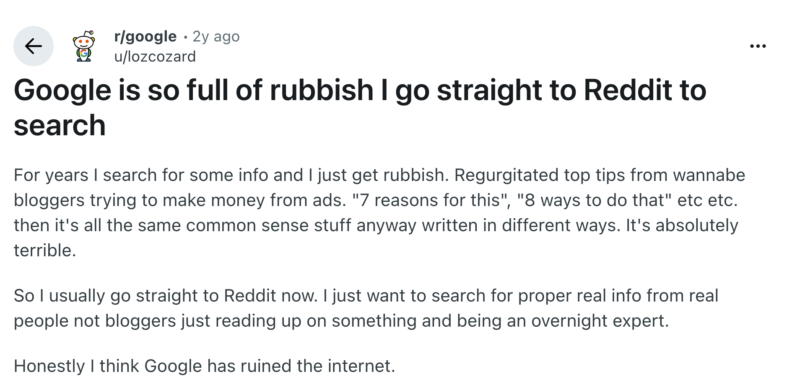
Source: Reddit
Let’s see why understanding user intent matters so much, and how you can practically use it to get better results from blogging.
It goes beyond the four search intent types
Traditionally, there are four types of search intent in SEO:
- Navigational. I need a particular website/page.
- Informational. I want to learn something.
- Commercial. I’m comparing the options.
- Transactional. I’m ready to buy or take another action.
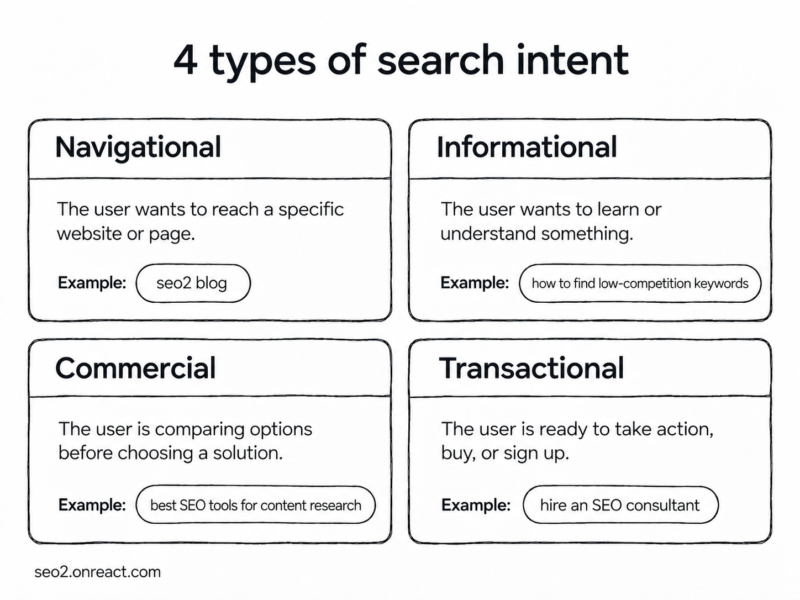
These are helpful, but they aren’t enough.
These four buckets are too broad, so they simply can’t tell the full story.
For example, people looking for “how to go viral on TikTok” (informational intent) might have very different motivations:
- One user might be a small business owner who thinks that going viral will help them get more clients.
- Another person might want to become a full-time blogger or influencer.
- Someone else wants to earn through affiliate marketing, so going viral is a chance to get more clicks on their affiliate links.
Even though all of them want their video to blow up, they have very different reasons.
Now imagine you choose this keyword and write a typical article like How to Go Viral on TikTok: 10 Best Practices.
What this title does is try to address everyone at the same time.
Yet, as it often happens, when you target everyone, you end up reaching no one.
That’s why, instead of writing that generic guide, you can address your target audience with their unique challenges. For example:
- If you’re targeting that small business owner, you can tell them that filming viral trends won’t necessarily help them sell their product or expertise.
- And if you write for that affiliate marketer, it’s worth asking whether their viral video will even feature the product they’re promoting. Or will it be just another funny TikTok dance?
See how the motivation behind each search completely changes the angle?
And this applies to every piece of content you create, whether it’s a LinkedIn post promoting your service or an outreach email pitching a guest post.
You might want people to buy from you, subscribe to your newsletter, book a demo, or get your content published.
Yet it’s nearly impossible to achieve any of that without knowing what the person on the other end wants.
That’s why, before you type a single word, try to understand the person who will read it.
Successful content is always about them, not you.
It’s impossible to write valuable content without understanding your customer
Blogging usually starts with keyword research. Still, is it enough?
Here is an interesting take from Eli Schwartz on what’s more important than keywords. Spoiler: your customers.
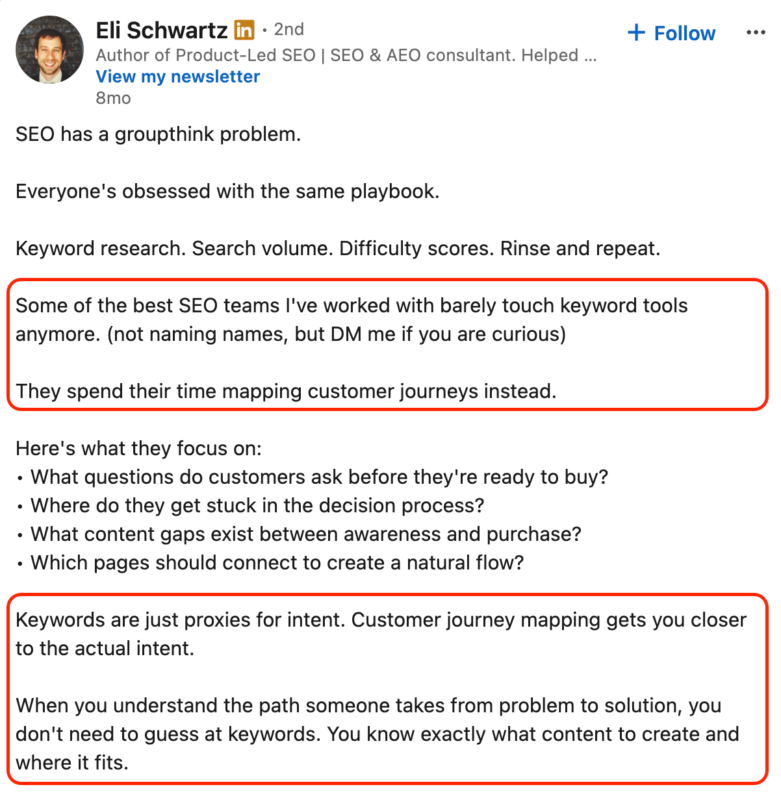
Keywords are just proxies for intent.
Eli Schwartz
I’d still argue that most businesses don’t need to skip keywords entirely. They’re still useful.
So, start with good niche keyword research to see what your audience is interested in.
Just don’t stop there.
You also have to understand the why behind each keyword.
Broadly speaking, your goal is to find out what made your reader search for that keyword in the first place.
To get more context, you can use this simple framework:
- As a … (who): Small business owner
- When … (situation): My business isn’t bringing in enough leads
- I want to … (motivation): Understand how TikTok algorithms work
- So I can … (desired outcome): Get more leads without paying for each click
With this approach, you simply can’t write a generic blog post anymore. Why?
You have a real human being with a clear motivation and outcome in mind.
The key, of course, is to choose your target reader based on your business and offer.
What happens when you understand your reader
Here is a great real-life example where the writer reviews something as boring as air purifiers. Yet he understands the search intent perfectly.
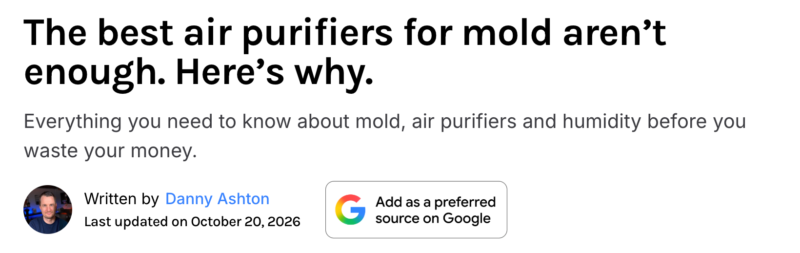
Most people don’t look for air purifiers because “it’d be nice to have one.” No, they look for it because they are tired of mold in their house.
So, apart from giving his readers a list of air purifiers, the author also addresses:
- How important it is to understand what spores you’re trying to catch
- Whether you really need an expensive HEPA filter
- Why an air purifier alone isn’t enough to solve the mold issue
Yes, he recommends the best options with a detailed review of each.
Yet he does much more than that. He gives people the answers to questions that bothered them before they even typed anything.
Now guess what? This guide performs extremely well SEO-wise.
It ranks for 212 keywords, most of them in the top 3. Notice how many problem-focused queries it has managed to show up for.
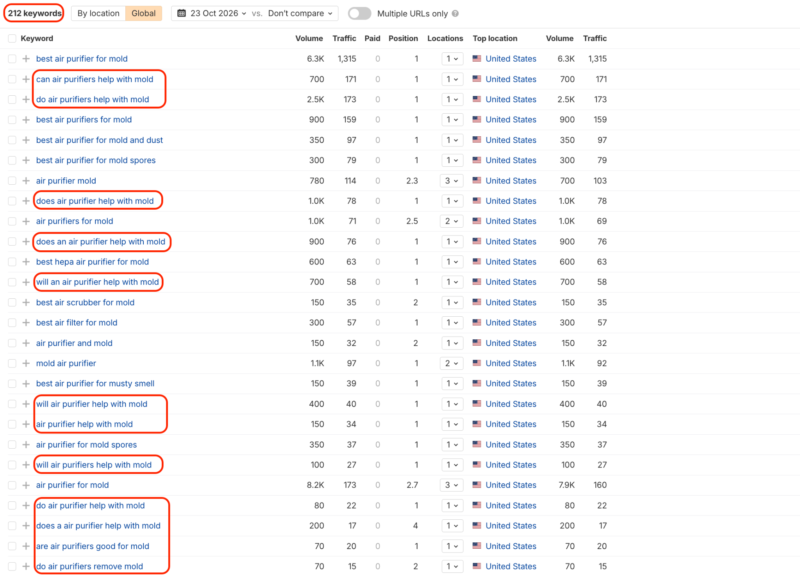
This is how search intent optimization works in practice.
One of the easiest ways to understand what people are actually looking for is to check the People also ask section in search results.
If we google the main keyword from the article above, “best air purifiers for mold,” we’ll see that users are wondering whether an air purifier can even help with mold at all.
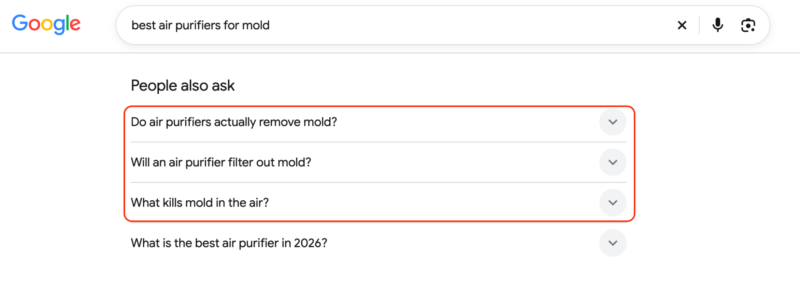
Even something as simple as checking People also ask can make your article much more practical and valuable to your readers.
Top-ranking articles might miss the point too
Can’t you simply look at what the top-performing articles do and replicate that?
While this is a typical approach in SEO, it doesn’t always help you understand intent.
Most sites have the same approach to blogging. They check the top 5-10 search results, mix and match all the info, and write something a little better, a little longer, and a little more detailed.
As a result, you get 10, 20, maybe 100 nearly identical articles that simply remix generic ideas.
Yet are you sure the other websites actually got the user intent right? You simply can’t know.
That’s why it’s so important to go beyond competitor content analysis. Try to understand the real gaps and what people actually want from a search.
How can you practically identify those content gaps?
- Go on Reddit and read what people actually struggle with. This is such an underused source of raw opinions and insights.
- Look at customer reviews for products/services in this category. Pay special attention to negative feedback. There, people often share their frustrations.
- Analyze your own customer support and/or sales calls. Usually, your users talk about much more than just your offer. They often share industry-level challenges or desires.
You can also copy and paste everything you find interesting during your research and ask any LLM to organize all those messy thoughts.
This can help structure all those findings and make your search intent optimization easier.
When no blog post is the best solution
Not every keyword needs a blog post.
When you put it like this, it sounds obvious. Yet businesses often forget this when they start actively working on their SEO.
Let’s take a look at cases where an article isn’t the best answer.
People need a different solution
Sometimes people don’t want to read another “complete guide.”
Their intent might be much more practical. They want to get an actual:
- template
- tool
- checklist
- video tutorial
- whatever
The point is that simply writing a long read that ranks won’t necessarily help your readers or lead to any business results.
For example, when someone searches for a “content plan template,” they don’t want to read an article with headings like “Do you need a template?” or “What kind of template do you need?”
They just want a template.
And if you have any practical, not-so-typical thoughts on the subject, you can share them later on in the article. Still, first, give people what they ask for.
AI can answer your question in seconds
“SEO is dead”. That’s what we started hearing a lot with AI search.
This is just one example of a website ranking #1 for “in-house SEO” (a keyword with over 200 monthly searches), and getting exactly zero clicks.
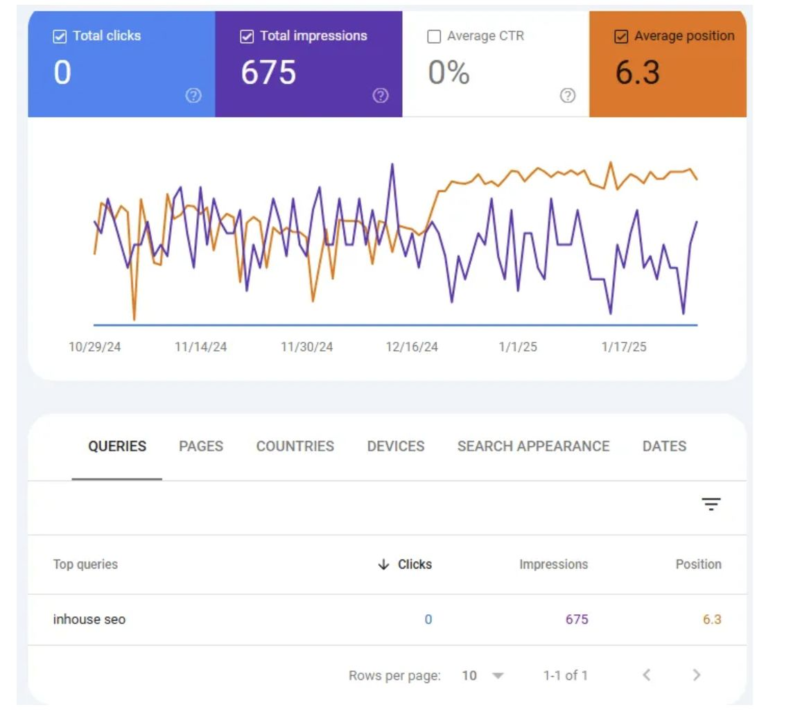
Is AI search really the reason for that? Well, yes and no.
Long story short: AI can answer most basic informational queries in seconds. Things like “What is SEO?” and “What is the difference between blue ocean and red ocean in marketing?”
This has caused a fair share of panic.
Yet in reality, targeting those keywords was quite pointless for a very long time.
They don’t add anything new. They don’t show your expertise. They don’t help people convert.
So, now is a perfect time to finally focus on unique, non-commodity content. Instead of writing another generic top-of-funnel informational piece with no added value.
If you want to better understand why the zero-click problem isn’t really a problem, just read this guide.
Your article has no connection to your offer
Sometimes, companies write content just to get traffic and rankings.
You find a keyword that has good search volume and low keyword difficulty. Everything seems fine, except it’s hardly connected to your niche or audience.
Yet what’s the point of having clicks if they don’t help your business?
It doesn’t mean that you can’t blog for brand awareness or to build your expertise. In fact, those are great reasons to blog.
Still, you can’t do any of those if the keywords you target don’t match your product/service and your target audience.
Here are some examples:
- There is a good keyword that targets small businesses, but your target audience is enterprises.
- You sell a high-end service, but target search queries about how to DIY that same service.
- Your goal is to reach businesses that want to hire freelancers, but you write content for freelancers.
All these pieces can rank well, but are they really useful?
Why are you blogging?
The point of this article isn’t to make you feel like blogging or traditional SEO optimization is useless. Not at all.
The goal is to encourage you to understand why you are blogging in the first place.
Information is abundant these days. And no one really needs another recycled article.
Yet people still have their:
- doubts
- motivations
- struggles
- uncertainties
- and goals
And many of those things can’t be resolved with an AI Overview summary.
So, if you want your blog to succeed in this AI age, you need two things:
- Understand the real search intent behind the topics you target.
- Address that intent clearly, supporting it with your unique perspectives and experiences.
Blogging for SEO purposes isn’t an issue. The problems start when you think SEO is just keyword optimization. And it isn’t.
SEO is about reaching the right people with the right answers. That’s it.
Everything else we do, whether it’s adding internal links or optimizing page speed, just helps us get there.
Search engines were created to help people. That’s why the basics haven’t changed.
They have just become more obvious these days.
*About the post:
This is a collaboration with Jessica Harris from Adsy and Alexandra Rumiantseva, a content marketing writer.
I (the owner of this blog), Tadeusz Szewczyk, edited and fact-checked it.
Related posts:

How to Use Reddit for Social SEO Without Acting like a Jerk

The 10 Most Obvious Benefits of X/Twitter for Business

Do You Still Need a Website As a Solopreneur? It Depends!

Down-to-Earth Nonprofit SEO Approach: Advice and Resources
Where to Buy Links? How to Get Link Juice? Do Follow SEO Advice!

Suffering from HCU? Holy Cow! Helpful Content System Agony

What the Heaven is Paradise SEO? The Garden Eden of Natural Links

What Does My Bounce Rate Really Mean?