
I promised you a new definition of SEO when I started this blog.
Thus I called it SEO 2.0 back in 2007! Finally it arrived.
What is SEO in the twenties of the 21st century?
SEO is “Search Everywhere Optimization” by now!
Read on to find out why!
What is SEO for me and everybody else?
First off I don’t view SEO as everybody else!
What is SEO for me then?
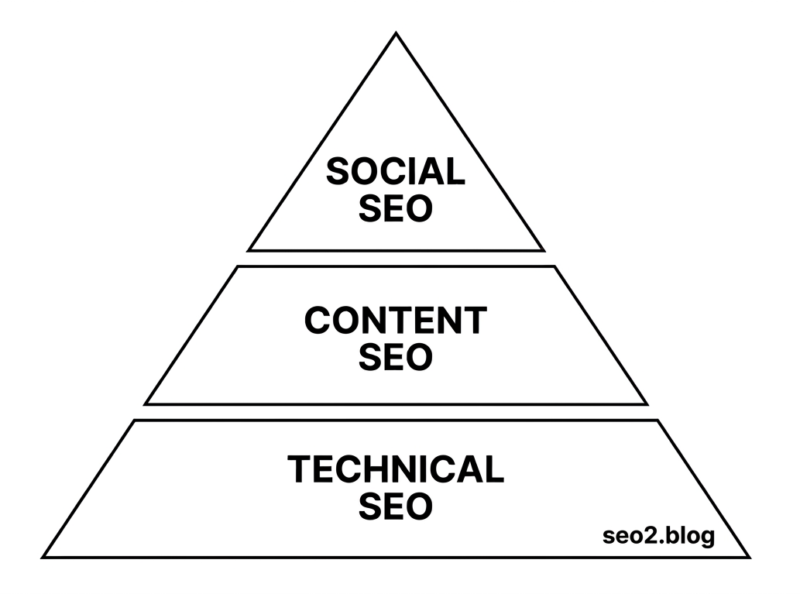
It’s a combination of
- technical
- content
- and social SEO.
Am I talking about the same SEO everybody else does?
Don’t think so. It’s similar but different nonetheless.
Most people mean the bottom part of SEO, the technical foundation, when they say SEO.
It’s the basis of successful SEO. You need it to get crawled, indexed, and displayed properly.
A broken, insecure or slow site won’t rank well.
Yet it’s content SEO, often called content marketing, that ensures there is something to get found at all.
Ultimately it’s the social SEO layer on top that decides whether this content will be taken seriously by people and bots.
When nobody shares and recommends your site or content Google algorithms etc. won’t either.
SEO is ever changing like a chameleon.
And I’m still looking for a new definition SEO.
Yet often I just follow its organic change to adapt to the latest Internet landscape.
Many people suggested new ways of seeing it or even came up with disciplines and acronyms.
So where is SEO now according to me and industry experts?
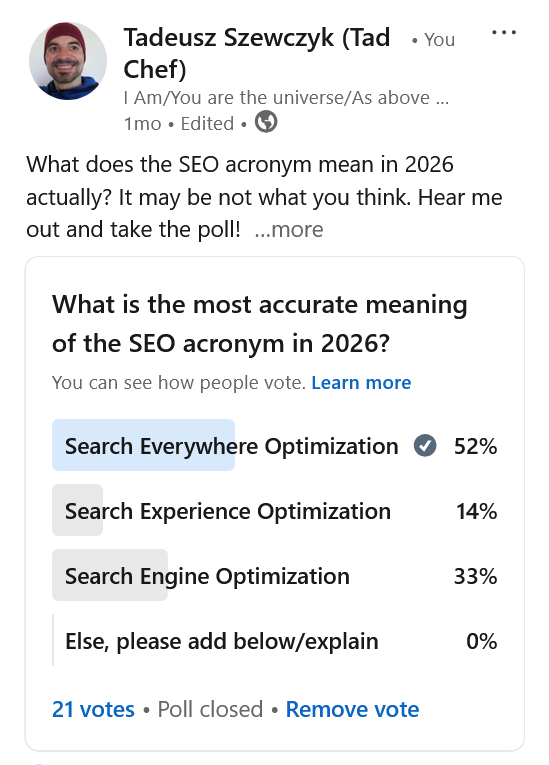
A growing number of SEO experts agrees that it’s Search Everywhere Optimization by now.
More than half of SEO experts polled on LinkedIn chose “everywhere” as the most accurate SEO meaning in 2026!
How that?
People don’t just use Google to search for things.
Is SEO inherently social and thus social SEO by now?
Social media are all over the place.
Many people are also fed up with large scale social media run by billionaires for various reasons by now.
They also attempt to degoogle and search on all kinds of (social) platforms (TikTok, Pinterest, ChatGPT).
Yet social SEO as I perceive it is more than optimizing for search across the board.
What else is social SEO then?
Or should I say “modern SEO” as I often use that term?
Some even claim that AI SEO is SEO 2.0 by now.
Its not about the tools or technology though.
It’s about the approach you have when it comes to SEO work.
It’s the inherent socializing in all of it. The most successful brands socialize with their audiences actively on third-party platforms.
Sites like Reddit or LinkedIn became more important for businesses ever since chatbots get their quotes from there.
Adapting to the evolution of the Web
The Web evolves at an amazing pace and even accelerates.
We just try to come to terms with it.
What else does SEO mean then?
Yes, the SEO acronym still stands for Search Engine Optimization usually.
Yet let us take a look at the current stage or definition of search on the Web.
Classic search in the sense of search engines – robot driven data bases – works in a way many people can’t cope with.
You basically have to know already what you are looking for in order to find it.
It works like a dictionary.
You need a term you want to look up, without knowing the correct term you are lost.
With the advent of conversational AI we can ask chatbots now.
In the meantime people also started searching all over the place.
They may search on
What happens with people who don’t know how to express their needs yet?
How do you know you need SEO for instance when you are not familiar with the term?
You will probably attempt to circumscribe what your are seeking.
Something like „How to appear on top of Google?“ would be a logical question to pose in a case like this.
So you can ask your favorite AI chat about it now.
Is SEO something else then by now? Is some new acronym like AEO or GEO better equipped to express the current reality?
Google wants to respond
Google couldn’t answer questions for many years. It just echoed your question.
Now that changed of course with the advent of AI Overviews and AI Mode among other AI driven features.
In the past you were lucky to find an instance of the same or similar questions others published on the Web in contrast.
What do you do when you don’t even imagine that something like SEO can exist?
Most people did not even know that you can influence search results, especially without manipulating them, in the past.
People still tend to stare at me when I try to explain SEO.
Now let’s consider Pinterest.
This is what an Adobe study on Pinterest search usage says:
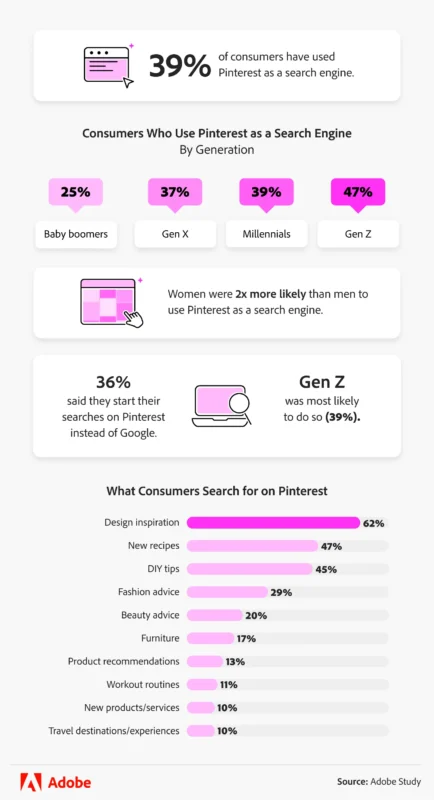
You probably do not think that Pinterest is a search engine do you?
I still call it image bookmarking.
Well, let’s look at what Pinterest actually does.
It suggests you images that might be of interest to you based on your preferences and what your peers like.
And you can search for similar images specifically based on an image.
Some call this a social discovery tool.
In any case people discover content and products not solely on Google.
They use
- social media
- AI chatbots
- instant messengers
plus a plethora of more traditional “channels”.
Yes, people still watch TV even if it’s online now and it’s called streaming.
Algorithm based curation on Pinterest and Google
Now let’s take a second look: Of course Pinterest has an algorithm.
Most social sites have one by now. Unless you don’t on purpose like Mastodon.
It attempts to sort and rate the relevance of content. It organizes content according to people’s preferences.
The only difference to Google is the kind of input the engine gets.
At Google the input comes from spiders crawling the Web.
These finds get ranked based on a plethora of human induced factors like links.
On Pinterest you have humans collecting and sharing content based on personal preferences.
Of course Pinterest also ranks your content based on how many people pin it and engage in other ways.
The more people interact the more other users will see it.
Moreover the more people follow you actively the more substantial your impact.
The more active you are on Pinterest the more influence you have.
On Google it’s similar. The search engine assumes that the older your website is the more authority it has.
And of course the more links it has among other ranking factors the better it must be.
Yet even the Google algorithm personalizes search results based on user input and interests.
Over the years some argued that SEO is thus
“Search Experience Optimization”.
They saw the merging of SEO and UX (user experience) signals as the main course of search evolution.
This definition of SEO did not go mainstream either though.
Just like my attempt to rebrand it as popularization.
Ironically I did not succeed at popularizing this idea!
Yet it was not mainstream due to health reasons IMHO.
The idea wasn’t bad at all. I just didn’t have enough energy to spread the word about it.
You don’t have to know what you want exactly
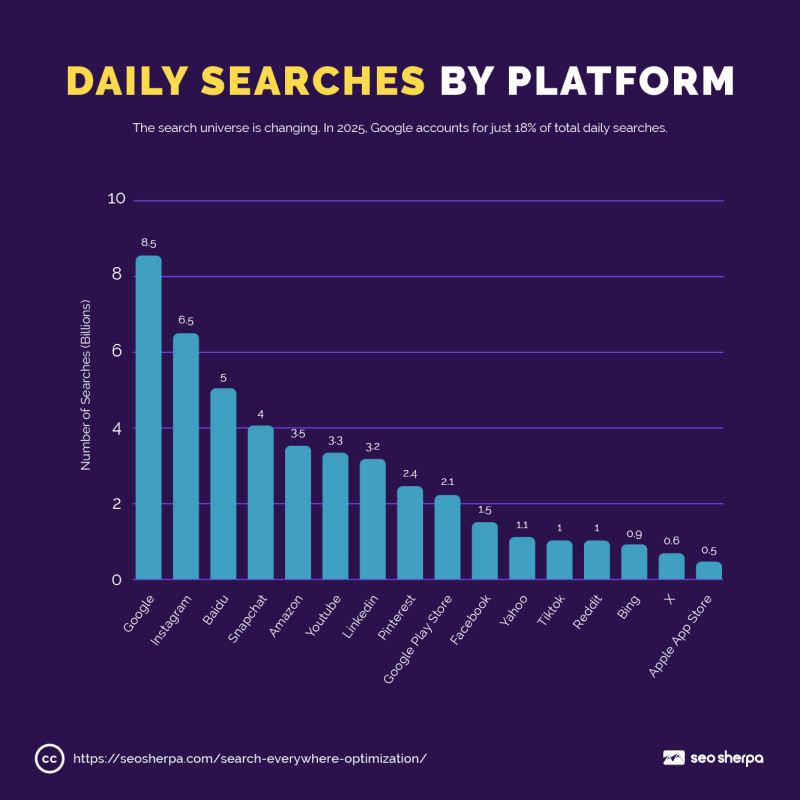
Around 2025 the idea gained momentum that SEO rather means “Search Everywhere Optimization“:
“Search today is scattered. It is no longer a straight path but a web of platforms, each serving a different purpose.”
James Reynold, Managing Director at SEO Sherpa
I didn’t even remember who suggested it first but it mainly referred to social media sites people increasingly used to search.
Rand Fishkin over at SparkToro has been documenting how people use various tools for search by now.
He literally confirms given his data from the SparkToro tool:
By now it’s widely accepted that you have to look beyond Google.
Leigh McKenzie of Backlinko summarizes it as follows:
You need to show up everywhere your customers are discovering, comparing, and deciding.
The main difference is that you do not have to know on sites like Pinterest what you are seeking.
A vague idea is enough to open up a whole sesame of precious jewels of the Web.
When you peruse a category like “Internet” you might find a site about SEO even if you didn’t know it existed.
A site like Pinterest might not be called a search engine. Yet technically it is one.
Of course this is no revolutionary insight I present here.
This is the most current new definition of SEO I want to present to you.
This is just an introduction though.
It’s only a post that will lead you towards more insights on a new definition of SEO.
Helping people is probably the most important aspect
So what is my unique take on SEO?
It’s it just that I prefer social SEO as I explain “SEO2” that way in some cases?
What is most important is that you keep in mind that SEO is about helping people.
Even Google officially affirms that ever since the Helpful Content Update (HCU).
How can you help? Help them to find the stuff they seek online while assisting others to be found.
Whether you use the term popularization or not it’s about the people searching ultimately.
It does not make sense to come up with new acronyms that confuse people each time a new trend in SEO arises.
We can make use of this term and make it reflect the changes that happen around us on the current Web.
Move with me and accompany me on the path to a new SEO.
What is your current definition of SEO?
Or do you use a different term instead?
Tell me on social media. I’m @onreact everywhere.
I might include your take in the original post here!
Related posts:
Social SEO Metrics to Use Instead of Website Traffic
Suffering from HCU? Holy Cow! Helpful Content System Agony
The Google Search Algorithm Explained in a Nutshell
In SEO Trust Matters: How to Build it then?
What the Heaven is Paradise SEO? The Garden Eden of Natural Links
Down-to-Earth Nonprofit SEO Approach: Advice and Resources
Is Topical Authority an SEO Hype or the AI Content Crap Savior?
The 10 Most Obvious Benefits of X/Twitter for Business
Do You Still Need a Website As a Solopreneur? It Depends!