Diamond Skull by Damien Hirst.*
Once in a while I check my social media feeds and see to my dismay another “SEO is dead” post.
This type of “ragebait” gets spread every year at least a few times by now.
Yet it’s nothing new.
The first “search is dead” post dropped by 1997, the year the term SEO was coined.
Thus it’s a recurring issue ever since SEO exists and I practice it.
To be honest I even used the same hook myself a few times:
- SEO is Dead! Long Live SEO 2.0!
- SEO is Dead – PIG is the New SEO
- Why SEO is Dead Serious: Google Hates Humor!
Yet I did not want to merely provoke back then. I also used it satirically.
In this post I want to show and explain how such ragebait works — that is misleading “news” meant to provoke anger.
How does ragebait work? Through “enragement”!
The “SEO is dead” hook is just one of many examples of ragebait.
It’s not just clickbait or mere link bait.
It uses negative emotions to trick you into supporting a piece of content by spread the word about it.
Ragebait is commonly used to manipulate social media algorithms and the public as a whole.
There are even various types of ragebait directed at the SEO industry.
Indeed ragebait or rather “rage bait” was the Oxford word of the year in 2025:
“Rage bait is defined as ‘online content deliberately designed to elicit anger or outrage…’”
Its usage peaked in 2025:
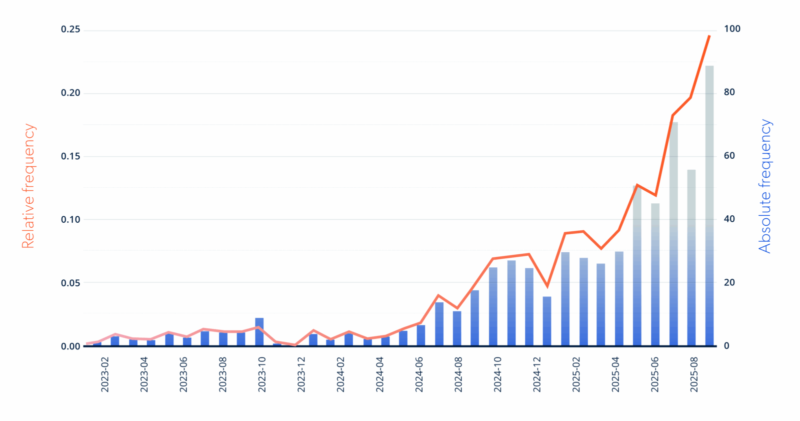
I welcome the arrival of this insight in the mainstream!
While at it I have no idea why they use a space between rage and bait as it’s clearly a compound word.
Two distinct words merged here to form a new meaning.
They are clearly not separate anymore!
Yet that’s not the main focus here.
For years I tried to explain it and rather used the variation hatebait.
So last time a post called “How SEO is breaking the web (and killing Google)” [sic!] has grabbed lots of attention.
Of course many of the shares were automated bots that push everything about SEO and Google.
Yet I guess there still were people around ignorant enough to spread this recurring nonsense.
Others simply fall for what I call enragement (engagement based on rage) and “ragebait“.
So how does ragebait, rage bait or hatebait work?
It’s pretty simple.
Something
- outrageous
- provocative
- unethical
or even downright wrong get posted online.
Often a vocal minority gets targeted with misleading news.
People get angry and publish angry responses.
They spread the word about the myth by their reaction already assigning importance to “news” that way.
How come people spread myths like that again and again?
Why aren’t more people educating themselves about SEO and how it impacts the Web (positively)?
Why people spread myths
Anger makes people irrational. Even I almost fell for it many times.
I consider responding myself each time to get my followers to ridicule the clueless person spreading the nonsense.
For the past few years I catch myself though before hitting publish.
I realize: “Ah, there is another ragebait!”
Then I decide to just ignore such posts. Years ago I also started writing this article here.
I wasn’t the only person to voice my dissent with this kind of polemic.
Most people are clearly stating that it’s nonsense to denounce SEO as a whole.
It can be any other vocal minority or even group of people.
Ragebait often targets vulnerable groups.
It can be
- transgender people
- immigrants
- women
Ragebait rarely targets those who already dominate the public discourse.
These underrepresented groups in contrast are often ostracized already.
So they get easily triggered when you exclude them in some new or nasty way.
Yet by adding comments and engaging with the misleading post people who disagree with it amplify it even further.
Raising hell by harnessing people’s outrage is the purpose of so called ragebait.
Controversial statements work well for attention grabbing.
Such posts garner thousands of views. What do people think about such posts though?
I guess like 2/3 are just shaking their heads in disbelief wondering: “How can somebody who is sane still spread such myths?”
How to deal with ragebait?
By now you might wonder how to deal with such a common verbal attacks on vulnerable minorities?
Don’t engage! You amplify it by engaging.
Do not even read it (it often amounts to masochism anyway).
Do not even click the link (as ragebait is usually also clickbait).
- Clicking
- viewing
- reading
all get measured as success metrics online.
The more attention you give the more “popular” you make such ragebait content!
Your engagement metrics signal the importance of the post to the algorithm.
Hence more people will be shown the same piece of content.
What else then? Report!
Many if not most social media and publishing platforms prohibit hate speech.
Ragebait that targets minorities, even professions like SEOs is by definition hate speech.
Also many platforms allow you to hide content so that you don’t have it anymore or see similar content in the future.
So report first and hide then.
You can also block the user so you don’t get such ragebait served in the future!
No matter what you do: don’t feed the troll!
The more you react by adding “angry” reactions or emojis the more push the lies and hurt others in the process!
Thus you have to strictly
- report
- hide
- block
and refrain from any public engagement with the ragebait.
Some people go as far as making a screen shot and sharing that instead.
Does that help?
No! Even when you share the “news” without mentioning or linking the original post it hurts your cause.
Just mentioning the myth you debunk already reinforces it!
Just referring to the outrageous content popularizes it!
Instead you can:
- Point out the truth!
- Share the facts instead of repeating the myths, even in “quotes”.
- Do not mention the lie to spread the truth!
Don’t say “‘the sky is green’ is not true’” Just say “the sky is blue!”.
So you see, even this post further spread the word about the myth.
Yet I had to mention the ragebait to make sure the context is clear.
This shows how insidious the ragebait trap is!
Once you mention the ragebait you already lost!
Another “opinion leader” talking nonsense?
Back in the days such ragebaits were still the exception.
Only online celebrities — we did not call them influencers back then yet — would spread them.
People only famous for being famous raised hell to get even more attention.
They had nothing to offer the public so they had to grab attention by sneaky ways.
Some referred to them as “opinion leaders”.
Opinion is judgement without proof.
So anybody can become one essentially.
You just need enough people who spread the word!
Nowadays even the US president uses ragebait all the time.
So it’s very common.
When I published this post originally it was dealing with just another “SEO is dead” bait.
A new search feature called “Google Instant” has been released.
Online celebrity Steve Rubel – who had badmouthed SEO in 2008 already – did it again:
His “Google Instant kills SEO” nonsense got more than 1.5k retweets and numerous links.
Does the “SEO is dead” meme still work? Yes and no. Back then I wrote this:
“SEO is dead” is dead.
Google itself offers official SEO advice at least since 2008 when the very first SEO Starter Guide has been published.
Back then time high profile Google personalities including Sergey Brin himself debunked the “SEO is dead” myth.
They did it right away during the Google Instant presentation.
Also Marissa Mayer who then worked for Google and Google’s “Head of Webspam” Matt Cutts stepped in.
They declared that SEO is alive and kicking.
SEO is alive but ignorance is as well.
That the “SEO is dead” meme is dead.
Yet sneaky attention grabbers use that ragebait every year.
Thus ragebait is also still working for some.
It just does in the short term though.
Who will believe online celebrities like Steve Rubel after being debunked by industry leaders right away?
Who will trust them when their misguided interpretations of Web reality get refuted within minutes after publication?
Yet trust is one of the most important things on the Web and beyond.
Stop killing in the name of attention!
Get over it. SEO is here to stay.
As long as there is search on the Web!
Websites will have to get optimized for searchers.
Even without websites content or ideas will spread.
Thus don’t behave like an idiot just to get noticed!
The old stereotypes don’t work anymore.
You just embarrass yourself ignoring the obvious and stating that “SEO is dead”.
“SEO is dead” is dead and you will also be dead on the Web in case you spread myths like these.
Who is this Steve Rubel anyway?
At least I still knew what the other influencers were doing who have declared SEO dead in the past.
Yet I don’t even know what Rubel does.
He’s a PR guy and a failed blogger. His blog has been offline for many years by now.
Influencers like Rubel are mainly popular because they already grabbed the attention of many unsuspecting onlookers.
Thus I rather still call them celebrities. They seemingly don’t do anything else but talking about others.
Probably most people will know him as the person who declared SEO dead while even Google execs disagreed.
The “x is dead” headline formula is overused anyway.
Stop killing in the name of attention!
Don’t grab attention by being a jerk. It hurts yourself.
Also do not fall for ragebait. The agent provocateurs trick you by making you angry.
Plus take note that I wrote this post originally in 2008.
Even by then the “SEO is dead” meme was a running gag.
It’s 2026 already and still every “new” year the same myths gets spread.
In 2025 “GEO” was used to spread thy “SEO is dead” myth.
By 2026 Google specifically documented how SEO is useful for AI search optimization as well.
For a few years I had a microsite called isseodead.info simply saying “no” in huge letters.
Yet I discontinued it after a while because I was bored by the phenomenon.
* (CC BY 2.0) Creative Commons licensed mage by Aaron Weber.
Related posts:

How to Use Reddit for Social SEO Without Acting like a Jerk

Is Topical Authority an SEO Hype or the AI Content Crap Savior?

What Does My Bounce Rate Really Mean?

Why GEO Can't Replace SEO

Is This the Best Affordable Semrush + Ahrefs Alternative for Small Business?

Suffering from HCU? Holy Cow! Helpful Content System Agony
Where to Buy Links? How to Get Link Juice? Do Follow SEO Advice!

The Google Search Algorithm Explained in a Nutshell