Back in the days search was about the proverbial “10 blue links”.
They lead to actual results on third party websites.
Not anymore. What happened? Universal Search!
In this post I will show you some simple ways to use Universal Search to appear on top of Google.
We’re talking about organic (unpaid for) search results and features here.
What is Universal Search and why does Google push it?
Nowadays Google is all about so-called “Universal Search“. What does that mean?
By now every search result on Google and increasingly on other search engines looks like a portal.
Search results are a combination of all kinds of media and resources.
- images
- videos
- maps and local results
- knowledge panels
- AI Overviews
- People also ask (PAA) questions
Apart from that most of the visible area of search result is cluttered with ads and Google’s own properties.
Thus you will have to scroll in most cases to find the remnants of the organic search results.
There are two reasons for Google to push Universal Search results whenever possible:
- it makes visitors stay on Google properties
- that way searchers see and click more ads.
In social SEO or SEO 2 there are many ways to influence such search results in the broadest sense.
There are still lots opportunities when it comes to Universal Search.
This term basically signifies that Google adds all kinds of other media and content types to their results.
You can use these additional ways to get on top of Google search results.
They work at least temporary or for some users, but in many cases also permanently.
In any case they can attract more visitors to your site or at least get more eyeballs for your content shown or hosted on Google.
Google Universal Search SEO techniques
I present to you the simple ways to use Google Universal Search to appear at the top of the Google results.
These Universal Search SEO techniques are often easier to implement and less time-consuming than conventional SEO.
It often takes months or years to rank organically.
SERP features like AI Overviews or PAA can fast-track you to the top.
Let’s start with the more established search results features.
Google Maps
This one is one of the most common ways to appear above your competition on Google results.
To appear here you need appearances in local directories and reviews. Sites like
- Yelp
- Booking.com
- Tripadvisor
will be used as local citations. Incoming links do not suffice.
Reviews on Google itself are of course even better.
Obviously it’s great for hotels and local businesses. The more reviews you get the higher you end up.
Even in case Google does not show you on top (yet) you will benefit from the traffic of these third-party sites.
Or searchers will directly contact you through them.
You are most likely already covered there and just have to claim your business in many cases.
Otherwise other people will decide how you get presented to the public.
Local guides visit all kinds of places like
- restaurants
- hotels
- stores
- clubs
to name just the most obvious travel-related ones.
As mobile searches dominate the local market some people even rename their business “[business type] near me”.
That’s a bit desperate though. Use a unique brand name and stay with it.
Ideally you just spot the satisfied visitors or customers and ask them for a review.
Otherwise mostly disgruntled ones will vent their anger in the worst case.
The number of reviews mainly counts for Google but when you only have one star reviews people will shun your venue.
YouTube
Let’s use an exceptional example for video results.
I once searched for a ventriloquist.
When you look for a ventriloquist on Google you will usually find 3 to 4 videos in the top 20.
Last time I checked there were all 3 from YouTube:
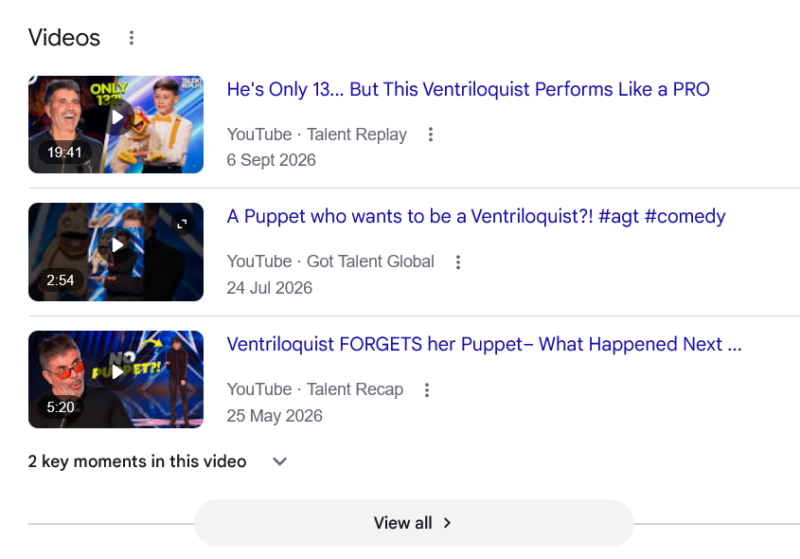
Obviously you should upload a video to YouTube to rank high on organic Google search.
You can also optimize for YouTube as a search engine as well.
It might be not that simple for this keyword as there are many videos, but it’s worth a try.
I bet there are lots of keywords where there are fewer videos.
That’s one of the best techniques for anybody who can sell something that will benefit from a visual representation.
That’s basically everybody unless you look too ugly to show yourself.
Then hire someone else.
Sometimes it’s as simple as repurposing your blog content as a video without filming much.
Screencasting will do as well.
It only shows what’s on your screen so you don’t have to dress up or put on make-up as nobody will see you.
Your voice should sound well though and your English be flawless.
Thus I can’t really do it either personally as English is my third language and my accent heavy.
Yet in the AI era some may appreciate such authenticity to prove you’re human not a bot.
Google Image Search
If you look for pop stars or artists you will in most cases see images above all the other results.
Try Britney Spears or one of the most notorious artists, Banksy.
While optimization for image search would take up a post of it’s own it is still by far simpler than link building etc. for a conventional #1 spot.
Yet even for a non-visual topic like SEO images can rank very well.
I rank for [outreach message] for example due to a post I have written many years ago.
It includes an annotated screenshot of an outreach mail I received.
Google News
While you might think that you are not The New York Times and you’ll never get there, it’s one of the easier endeavors.
These days you can simply submit your press release to a free press release site that gets featured on Google News.
You also might even set up a multi author blog and apply for inclusion in Google News yourself.
You can guest post at one if you need a quick success story. Look at the examples above:
Britney and Banksy search results both often include news.
AI Overviews
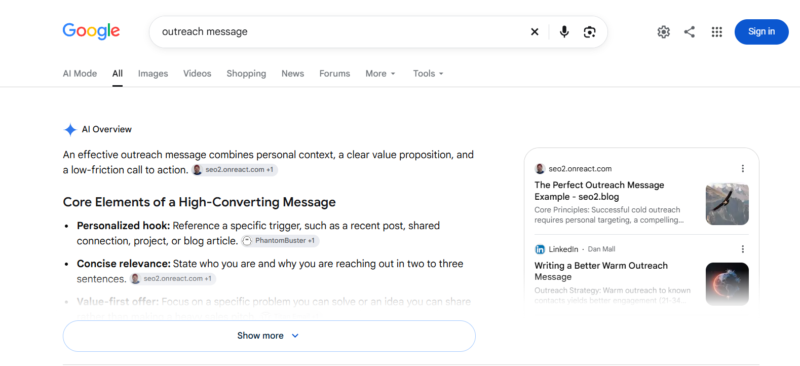
The elephant in the room are AI Overviews nowadays.
They show on most search results by now and take often the top and right spots.
They are somewhat connected to organic search but still separate.
Thus you can show up there and in other SERP features at once.
For example this blog here shows on top for the query [outreach message].
I show in AIOs, organically and in the image result. Yet the AIOs show right below the Google bar!
And I did nothing spectacular to get there. The post is just cleanly formatted so that AI can easily summarize the gist.
What other search features are there?
There are other types of Google special Google search features.
Tools like Semrush even track them.
Most are not as pervasive yet. For some topics and areas of expertise they already common though.
Thus please forget about SEO as a set of fixed practices like
- onpage optimization
- SEO content
- link building
SEO 2 is as multifaceted as the real world is.
Moreover consider that Google personalizes search results based on search history, location and Google Apps activity for example.
Therefore you might end up in the top 10 for SEO for some people (who follow you) while others won’t see you at all.
Related posts:

SEO is Alive! Celebrate with an Online Presence Consultation!

Your "Crawled – Currently Not Indexed" Message is not about SEO!
SEO Works! How? Step by Step + Project Examples
Where to Buy Links? How to Get Link Juice? Do Follow SEO Advice!

Down-to-Earth Nonprofit SEO Approach: Advice and Resources

What the Heaven is Paradise SEO? The Garden Eden of Natural Links

Is This the Best Affordable Semrush + Ahrefs Alternative for Small Business?

How to Use Reddit for Social SEO Without Acting like a Jerk