
As a modern SEO I deal a lot with increasing website engagement and thus decreasing bounce rates. It means:
I aim to make people visiting websites stay, read longer and ideally click something important.
Why is measuring the bounce rate important?
When people bounce off a website right away they don’t buy.
They also don’t share or link your content.
The bounce rate is a weird metric though. It doesn’t even have the same definition everywhere.
Even when you know and apply the definition of your particular analytics tool it’s the insight you are after not just the number.
So what does the bounce rate really mean?
The bounce (and engagement) rate definitions on Google Analytics 4
Let’s take a step back and define the meaning of the actual bounce rate metric.
Only then we can dive into deciphering what the meaning behind it is!
The most popular website analytics tool is still Google Analytics.
Yet many other alternative tools can measure it.
On Google Analytics it was one of the key metrics for many years.
Then Google Analytics 4 got rid of it and measured the opposite or engagement rate.
Nowadays bounce rate is back on GA4.
So let’s recapitulate the current meaning of bounce rate and engagement rate.
Google Analytics 4 defines a bounce rate as the percentage of visitors who don’t engage at all.
They leave a landing page immediately (that is stay below 10 seconds on it) without firing any “key event” onsite.
And they also do not view any other page on the same website.
The engagement rate is the exact opposite!
GA4 measures the percentage of sessions with 2 or more page views, at least one key event and 10s or more dwell time as engaged.
The legacy bounce rate definition on Universal Analytics and other tools
Classic Google Analytics and other tools define the bounce rate metric differently.
Before GA4 Google defined it on Universal Analytics as the percentage of visitors who have just visited one page.
They performed only one action on a given site and haven’t done anything else there. Thus they stayed also 0 seconds. Why?
There was no way to measure dwell time between two actions.
Most other tools still use a definition more akin to classic GA.
Some (partly free) analytics tools I use to determine the bounce rate are:
- Umami
- Betterlytics
- Ahrefs Web Analytics
- Cronitor
Yet the numbers wary.
For example for the past 24h the bounce rate is between 87% on Betterlytics to a whopping 94% on Umami! Why?
My Umami stats are overrun by bots from Asia that have 100% bounce rates!
Even despite using segments I still have bots from Vietnam or Singapore included.
Ahrefs shows a different time frame today/yesterday instead of the last 24h.
There the current bounce rate is an abysmal 98,6%. Why?
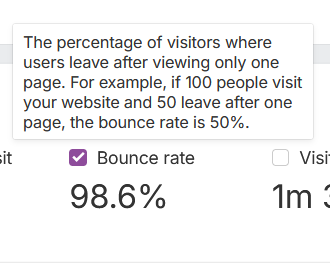
It’s due to the overwhelming bot traffic from Asia that warped the numbers completely.
Cronitor filters such bots by default yet they also slip through sometimes.
For sure there is room for improvement in my case, even though I run just an informational blog.
Why should I optimize the seo2.blog further?
Why not just ignore the high bounce rate?
What does the bounce mean regardless of definitions?
No matter which definition you prefer, the reality is the same in the worst case. The visitor
- arrives
- pukes
- and leaves immediately.
Measuring the bounce rate thus allows us to see bounces as a sign of quality or rather lack of it.
When 9 out of 10 people run immediately (90% bounce rate) you may have a problem.
Yet do not fret. Your site is not inherently flawed just because 80 or even 90% of people bounce!
The bounce rate definition means that in some cases even perfectly happy users are considered worthless bounces.
Sometimes people just want the information they look for (almost 60% of online searches are informational).
Thus they are satisfied. They found what they were looking for.
There is no need to click anything or view more pages. Yay!
Yet it’s not always the case! Thus you have to look closely.
What is a good bounce rate?
It depends! On what?
It may depend on a variety of factors.
What type of site are we dealing with?
Let me use an extreme example at first!
A one-page microsite where all the information is shown right there on the homepage would have a bounce rate of 100%!
There are many JavaScript based sites that work like that.
Even when users click they just get redirected on the same page by way of scrolling or link anchors.
So it depends on the site. Does it have pages at all?
Is it purely informational (a blog)?
Or is it an online store?
CXL even has benchmarks for different types of sites:
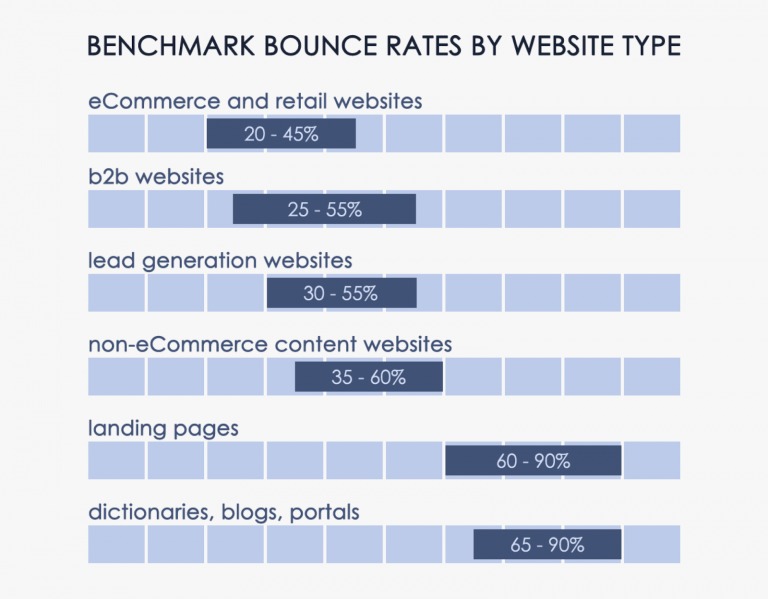
What a high bounce rate is changes then. For instance
the ecommerce sites (or online stores) I have optimized had bounce rates around 20% – 25%.
Why? The search traffic they mainly received was highly targeted.
In short the people got exactly what they wanted and expected! Why bounce then? On the other hand
the blogs I write for have seemingly abysmal bounce rates of 60 to 80%. Why?
Are the blogs so bad? No, people reading blogs are casual readers, especially when visiting from social media.
They check a post out quickly and decide whether they want to read it or not.
They the got what they wanted and don’t need to click other related articles.
Nowadays with a lot of bot traffic (I get hammered by bots from Asia e.g.) the bounce rate is often unreasonably high. Why?
Such bots stay just one page and bounce.
I sometimes have 100 visits per day from humans and 500 from bots. The bounce rate on such a day nears 100%.
Other circumstances also impact the bounce rate. The industry you are in also matters a lot.
Some things are decided quickly!
I usually buy the same type of food and drinks e.g.
Others are bought after careful consideration (travel, cars, homes).
CXL has also benchmarks for different industries!
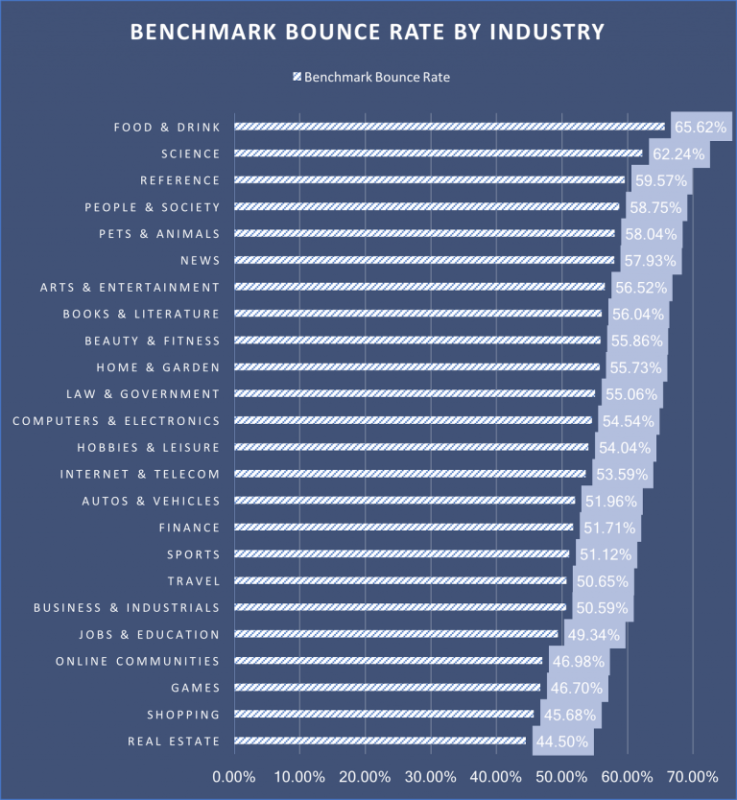
At the end of the day depending on the context your bounce rate of 50% can be awful, OK or great.
What does your bounce rate really mean?
Given the insights we have now bounce rate is far from random!
It can give you crucial insights into your visitors and their expectations.
A lower bounce rate can improve both the conversion rate and the return on investment.
When people bounce they can’t convert because they left already.
You really have to deal with bounce rates a lot or your business does suffer.
What sense does it make to get thousands of visitors when 90% of them just create load on the server without even viewing your site?
There we are in the process of interpreting bounce rates.
The right question is “what does my bounce rate really mean?
You can pose this question for each site and even on page level.
A bounce on the homepage is not the same as on a deep link etc.
Understanding the meaning of your bounce rate is the key to improving it.
It shows you how you can improve it.
It even helps to find out whether you really need to improve it in the particular case.
Instead you could even block some traffic sources or remove a page that just creates unnecessary load.
Some website owners block whole countries due to bot traffic!
How to make your visitors happy?

Once you determined that your bounce rate really is below average or too high for the wrong reasons ask yourself:
- How to make them happy?
- How to make visitors stay?
- How to make them click on more pages?
- How to make them click some buttons?
Then the next step is to learn more about your ICP or ideal customer profile.
What is their user intent? Is it
- informational
- navigational
- commercial
- or transactional?
Find out what your visitors actually want
1) First determine your page or site type and its purpose.
- Is your site a one-page-wonder like the microsite above or like Seth Godin’s blog where you end up happy after reading one or a few of his posts on the homepage?
- Is you site an ecommerce site or online store where you actually sell products on the same domain (not redirecting to a third party shopping cart)?
- Is your site a news site or blog? Is it another type of site where people seek specific information from it without planning to do or read more?
2) Then find out what kind of queries lead to your site.
Search engines are used mostly for four types of queries. They are:
- navigational (people who type [amazon], [facebook] etc. in the browser address bar or search input)
- informational (people who seek general or specific information on a given subject)
- commercial (people who want to research a product or us a service and who are informed already about it)
- transactional (people intend to buy a specific product they know the name of already ideally)
Depending on the query type most of the search users who find you use your bounce rate will differ significantly.
Navigational queries have often the lowest bounce rates as long as the people find what they seek.
When you search for Facebook you want to end up on it when you type it.
So Facebook has probably a very low bounce rate from these queries.
In the past one of my blog posts ranked very high for [facebook login]. Thus I got lots of people who searched for Facebook on it.
Most of them bounced of course.
Commercial queries have a low bounce rate in case the people really find the product or service they are after.
When it’s not around 20-30% you may want to check whether the products you are selling are the ones people want to pay for.
Informational queries lead the most fickle users to your site and thus have the highest bounce rates.
They often do not even know exactly if they really search for what you write about.
There are often misunderstandings when queries do not reflect the user intent at all.
For instance people searching for SEM do not necessarily seek search engine marketing advice.
Instead they may be interested in scanning electron microscopy which also uses the same acronym!
3) After that think about the ways you want your people act on your site.
Do you really want them to stay long and read lots of pages or do you prefer a quick conversion?
For affiliate sites a click on the affiliate link is a bounce in a sense but it’s also a conversion of course.
A visitor who finds the product you recommend as an affiliate and clicks on the affiliate link has been converted.
Yet they also view just one page on your site and leave instantly!
In contrast a news site that earns money by ad impressions wants you to stay onsite as long as possible!
Thus you will get shown more content and images will be split into many pages to make you click as often as they can.
That’s why image galleries on such sites tend to show only one image per page. They want you to see 10 ads instead of one.
Advance in the right direction

Now that you know all these things you can start improving your bounce rate.
Or you can focus on other parts of advanced SEO.
You can try to rank for more specific terms instead of the broad industry terms.
Ranking for “seo” may bring loads of traffic but “local seo for travel agencies” might be more effective at retaining visitors.
You can add commercial keyword modifiers to make the purpose of your site clear.
This way people who just seek information don’t visit at all.
- A very broad keyword like [seo] might lead lots of people to your site who just want to find out what it is in the first place.
- A more specific key phrase like [seo services new york] might bring you both clients and people from your area.
They are probably more willing to deal with a local service provider.
Also don’t be just after generic keywords when it comes to SEO.
Use brand names as much as possible! Brand your products, services and even techniques.
Branding efforts beyond old school SEO might make people more aware of your business.
By establishing a brand you are making people search for it next time (aka using a navigational query).
They are less likely to bounce again when they already know you in contrast to generic terms like [seo services new york].
Remember to ask yourself: What does my bounce rate really mean before trying to improve it.
When it’s not broken don’t fix it. Otherwise improve your site quality accordingly.
Related posts:
Do You Still Need a Website As a Solopreneur? It Depends!
All You Need to Know About Blogging in one Place!
Why SEO is Dead Serious: Google Hates Humor! #seohorrorstories
Social SEO Metrics to Use Instead of Website Traffic
The Google Search Algorithm Explained in a Nutshell
Is This the Best Affordable Semrush + Ahrefs Alternative for Small Business?
Is Topical Authority an SEO Hype or the AI Content Crap Savior?
Suffering from HCU? Holy Cow! Helpful Content System Agony
How Do "Stay on Google" Searches Impact SEO?