 *
*
Simplicity is the ultimate (form of) sophistication
Leonardo da Vinci
Design or self improvement are two of my favorite topics.
For both simplicity is widely accepted as the path to success.
When it comes to blogs, social media or search many people still overlook it.
It’s worth being appreciated though!
Just think of the biggest successes in all three areas:
- Google introduced the clean and simple search box homepage.
It soon replaced the cluttered portals of the 20th century that were dominating back then.
Of course many aspects fueled it, the better results, the young sympathetic team, the playful corporate culture etc.
Nonetheless the simplicity in web design or UX as we call it today played a major role. - On social media one of the most successful sites was Twitter (now X).
It achieved stellar success by its super simple approach to publishing.
The limit of characters and lack of features was exactly why everybody started using it. - Legendary social network and blog platform Tumblr still thrives.
Tumblr made blogging simple again and took over myriads of users from WordPress and Blogger.
Additionally they got high numbers of users from Facebook and other social sites.
These people were not even into blogging.
OK, I hear you saying:
“yes, but these are huge corporations!”
and
“I’m just an average business person.”
How does simplicity actually work?
How does simplicity work on blogs, social media & search?
Can simplicity make real life business owners without millions in venture capital succeed?
I could offer you many examples of people who have succeeded by simplifying. One is enough though.
Zen Habits by Leo Babauta is probably the best example of success through simplicity.
The author has a very popular blog with a huge faithful audience.
It stood the test of time. It exists for decades by now. It’s live since 2006!
While he treats SEO with disdain and isn’t optimizing for any major keyphrases like
- [self help]
- [personal development]
- [life hacks]
he nonetheless ranks on top for some of his evergreen articles.
He wrote one on calmness in 2013 and is still #3 on Google from the US for the term.
The blog gets only outranked by Wikipedia and a dictionary:
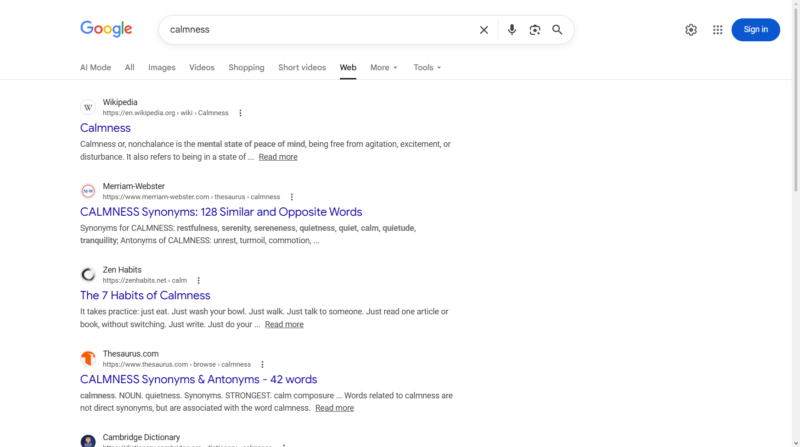
I’ve read a lot of other self improvement blogs by authors who are even more sympathetic.
Yet none of them has a similarly big audience.
Then what do the other self improvement bloggers wrong?
- They have shiny interfaces with lots of colors and images.
- They push their latest ebooks on their blogs.
- They have very long and sensationalist post headlines.
- They have lots of guest posters from other blogs.
- They display lots of social media buttons everywhere.
Now you may wonder:
- Are these things really wrong?
- Aren’t everybody and their aunt suggesting them?
- Haven’t I suggested myself to do some of these?
Well, apparently adding more and more, be it features or items or authors or whatever isn’t always the best solution.
The people of our age are bombarded non-stop with messages, things and offers.
Do not force even more down their throats. Try it with less.
- fewer features
- less clutter
- shorter headlines
Skip too many “long tail” keywords.
- For my blog I focus on a lot of white space.
- The design is clean and simple with a focus on the content.
- The sentences and paragraphs are short and readable.
Back in the days I have even banned Google here on my blog to be able to return to a less Google-pleasing writing style.
That’s why my readers are returning. Some of them are with me for many years by now.
* “What is simplicity” poster by Paweł Kadysz.